
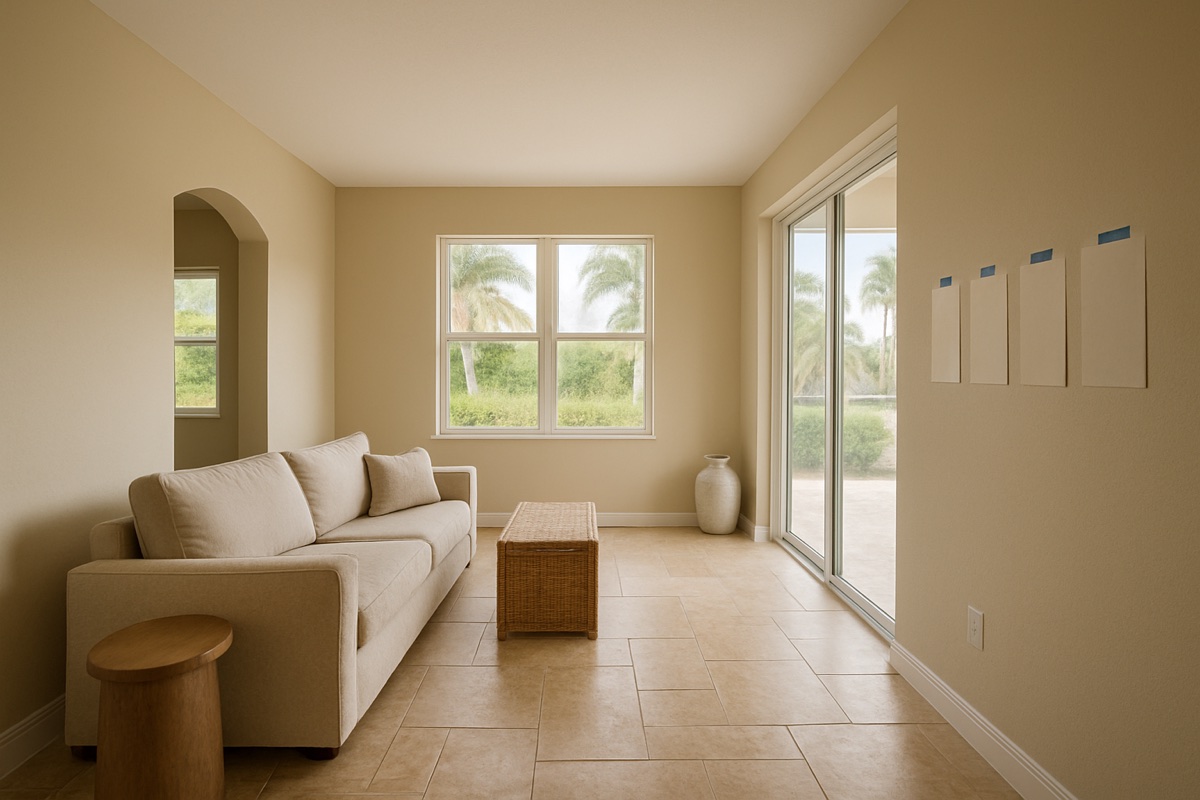
Choosing interior paint colors for your SWFL coastal home involves more than flipping through a fan deck. Southwest Florida’s strong natural light, seasonal humidity, coastal exposure, and bright afternoon sun can all affect how a color reads once the paint dries. A soft linen sample may appear much brighter or pick up an unexpected undertone in a Fort Myers great room. This guide covers practical palette, finish, primer, and accent considerations for Lee, Collier, and Charlotte County homes.
How SWFL Light and Humidity Change the Way Paint Colors Read
Strong natural light can change how undertones appear throughout the day. Warm yellows may look brighter at midday, cool blues can shift toward gray-green in the late afternoon, and saturated colors may show wear sooner when the sheen or product is not suited to the room. Test each color in the actual space before making a final selection.
Humidity is the other major variable. Cape Coral, Bonita Springs, and coastal Naples homes run their air conditioning year-round, which creates a cycle of warm humid outdoor air meeting cool interior surfaces near windows and exterior walls. Paint films that are not formulated for high-humidity environments can trap moisture and begin to peel at seams, especially on older concrete block (CBS) construction where the substrate itself absorbs and releases moisture seasonally.
When you’re evaluating paint colors, do these two things before committing to a full room:
- Purchase sample quarts and apply two 12-by-12-inch patches directly on the wall: one near a north-facing window and one near a south or west-facing window.
- Observe each patch at three times of day: morning, midday, and after 4 p.m. The shifts you see in those six observations tell you more than any color-matching app can.
For CBS homes on slab-on-grade construction, check whether the walls show efflorescence or salt blooming before repainting. Those deposits can signal a moisture condition that should be evaluated and addressed before primer and finish coats are selected.
Neutral Palettes That Work in Coastal Southwest Florida Interiors
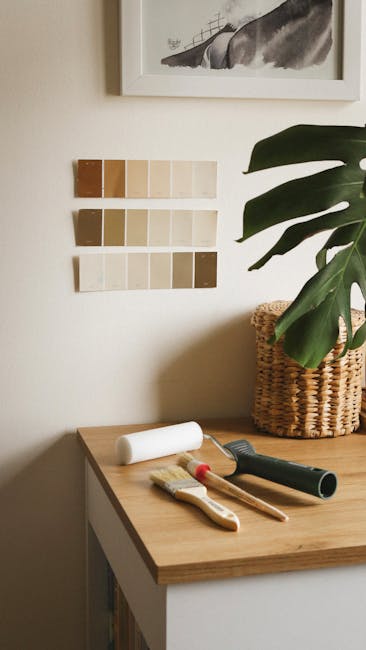
Warm-leaning neutrals such as greige, sand, warm white, and pale driftwood often coordinate well with coastal Southwest Florida interiors. Cool grays can pick up purple or blue-green undertones in bright natural light, especially beside sandy beige tile, shellstone, or travertine. Always compare samples against the room’s fixed finishes.
Here are four neutral categories that consistently perform well in SWFL interiors:
- Warm whites: Warm whites can read as clean and open without the clinical harshness of bright white in full sun. They often work well on ceilings and in rooms with lanai access, where outdoor ambient light reflects inside.
- Greiges: Colors in the beige-gray crossover can anchor open floor plans without competing with travertine or ceramic tile floors.
- Pale sage and eucalyptus: These soft green-gray tones reference coastal vegetation naturally. Sample them near windows and under evening lighting to confirm the undertone works throughout the day.
- Sand and linen: Mid-depth warm neutrals can read as cohesive and grounded in rooms with high ceilings and open floor plans.
A practical approach for an open-plan interior is to choose one dominant neutral, a slightly deeper secondary tone for selected walls or hallways, and a coordinated trim or accent color. This creates visual flow without making every surface feel identical.
Accent Colors and Coastal Palette Strategies for SWFL Homes
A coastal palette doesn’t require turquoise walls and rope trim. In fact, literal beach references tend to date quickly and can make a home feel themed rather than designed. A more durable approach uses coastal color logic (drawn from the region’s actual landscape) as accent rather than dominant color.
Blue and Aqua Accents Done Right
Blues derived from the Gulf itself (from the pale celadon of shallow sandbars to the deeper teal of open water) translate well as accent colors in entry foyers, powder rooms, and butler’s pantries. Keep the saturation moderate; pure navy or electric teal becomes overpowering in small spaces amplified by Florida’s light intensity. A muted seafoam or slate blue in a semi-gloss finish on a single accent wall or built-in bookcase achieves the coastal reference without overwhelming the space.
Coral, Terracotta, and Warm Earth Tones
Warm earth tones such as dusty coral, faded terracotta, and warm clay pull from the region’s sunset palette and native landscape. These can work well in dining rooms and primary bedrooms where evening lighting brings out warmer undertones. Product cost and coat requirements vary, so confirm coverage, primer, and application guidance for the selected paint.
Bringing in Outdoor-Indoor Continuity
SWFL homes frequently open to screened lanais, pool decks, and outdoor living areas. Coordinating your interior accent palette with the outdoor tile, pool finish color, and landscaping creates a visual throughline that makes interiors feel larger and more connected to the outdoor environment: a major selling point in the coastal Lee and Collier County market. Consider pulling a secondary neutral from your lanai floor tile as a wall color for the adjacent interior living space.
Paint Finish Selection for Florida’s High-Humidity Interior Conditions
Finish, or the sheen level of the dried paint film, matters as much as color in a high-humidity coastal environment. A finish that does not suit the room can be harder to clean, highlight surface problems, and shorten the useful life of the paint job.
Here is a practical finish guide for SWFL interior rooms:
- Flat or matte: Flat finishes can hide surface imperfections, but they are generally harder to clean. They are commonly considered for ceilings and lower-contact areas, subject to the product manufacturer’s room and moisture guidance.
- Eggshell (main living areas): The go-to finish for living rooms, dining rooms, and bedrooms in SWFL. Eggshell provides a slight sheen that resists moisture and can be wiped clean without burnishing. Look for formulations with built-in mildewcide if the home has any history of humidity intrusion.
- Satin (kitchens, hallways, high-traffic areas): Slightly more reflective than eggshell, satin finishes clean easily and resist the scuffing that hallways and kitchen walls take from daily contact. The sheen does highlight surface imperfections, so drywall prep matters more here.
- Semi-gloss: Semi-gloss is commonly considered for trim, doors, and selected moisture-prone areas because it is easier to wipe clean. Confirm that the chosen product is rated for the room and substrate.
For coastal and canal-area homes, ask whether the selected coating is appropriate for the home’s exposure, substrate, and moisture conditions. Review the manufacturer’s technical data for each product before application.
Paint is only one part of a home’s finish system. If there are signs of air leakage, moisture intrusion, or insulation concerns, have the relevant building condition evaluated separately before repainting.
If you’re planning a broader interior refresh alongside your repaint, our team covers the full scope of interior painting and finish work in Lee, Collier, and Charlotte counties, including surface prep, primer selection, and finish application on CBS walls and drywall.
Prep Work, Primer, and What to Expect During a Professional Interior Repaint
Color selection gets most of the attention, but preparation has a major effect on finish quality. On CBS walls, preparation may include repairing surface defects, addressing uneven areas, and selecting a masonry-compatible primer before the finish coat. The exact process should follow the condition of the wall and the coating manufacturer’s instructions.
On standard drywall, preparation can include sanding texture inconsistencies, patching nail pops and seam cracks, and priming bare or repaired areas before the color coat. The right preparation depends on the surface condition and helps reduce uneven sheen or visible repairs.
Interior repaint pricing depends on the measured area, ceiling height, number of colors, surface repairs, trim and door scope, access, and the selected coating system. A written estimate should identify the preparation, products, included surfaces, and exclusions for the specific home.
The schedule for an occupied-home repaint varies with room count, surface repairs, drying conditions, access, and whether cabinetry or texture matching is included. For a broader renovation, coordinate painting after dusty work is complete and confirm the sequence in the project schedule.
If you’re in the Bonita Springs or Estero area and considering a remodel alongside your repaint, explore our Bonita Springs remodeling services to see how painting fits into a larger renovation scope.
Frequently Asked Questions
Why do gray paint colors look purple or green in my Florida home?
Cool grays are formulated with blue or green undertones that become visually amplified under Florida’s high-intensity natural light and the blue-sky ambient light that floods SWFL interiors. The effect is most pronounced in rooms with large west- or south-facing windows. To avoid this, test samples on your actual walls and evaluate at multiple times of day before committing to a full room. Warm-undertone grays and greiges typically read more neutrally in SWFL conditions.
How often should I repaint the interior of a Southwest Florida home?
Repaint timing depends on surface preparation, product selection, traffic, cleaning, sunlight, humidity, and any moisture intrusion. High-use or moisture-prone areas may need attention sooner than lower-traffic rooms. Inspect the finish and address any underlying moisture condition before repainting.
Do I need a special primer for concrete block walls in Florida?
CBS walls generally need a primer or sealer compatible with masonry and with the selected finish system. If the block shows efflorescence or another moisture-related condition, evaluate and address the cause before coating. Follow the product manufacturer’s preparation and application instructions for the specific substrate.
Can paint color actually affect how hot a room feels in SWFL?
Lighter interior colors can make a room feel brighter and more open, while darker colors may create a more enclosed visual effect. Paint color alone should not be treated as a cooling solution. Building-envelope, glazing, shading, and HVAC questions should be evaluated separately.
When you’re ready to move from color samples to a finished project, Alliance Construction & Renovation is a licensed Florida general contractor serving Fort Myers, Cape Coral, Bonita Springs, Naples, and surrounding SWFL communities. We handle surface prep, primer, finish coats, and coordination with other trades so your repaint integrates cleanly into your home’s overall condition and value. Call us at (239) 771-2855 to schedule a consultation, or visit our painting and finish services page to learn more about what a professional interior repaint includes from start to finish.