
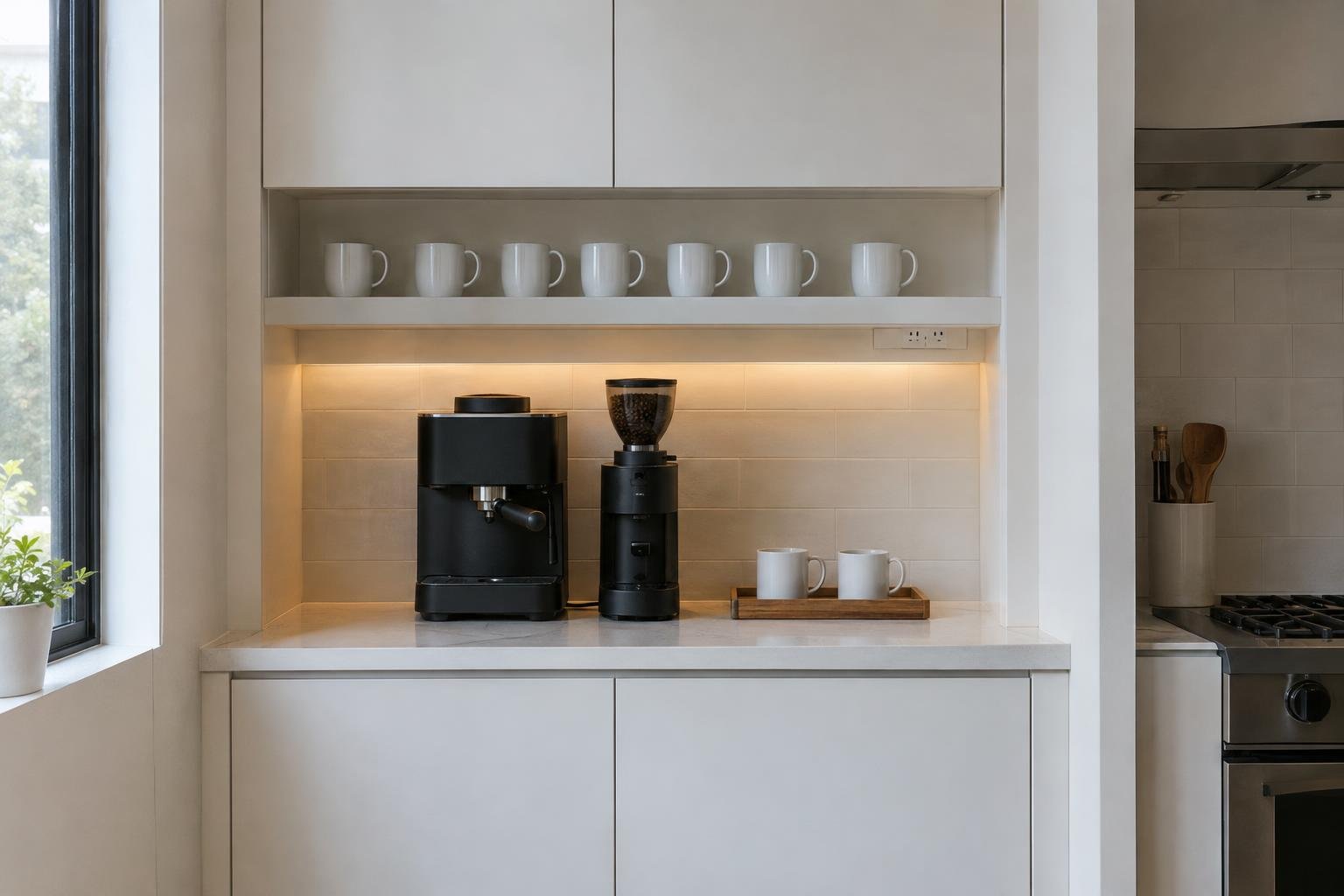
A good morning routine should not require a lap around the kitchen. The best kitchen coffee bar ideas share one trait: they put the grinder, the kettle, the mugs and the water within a single arm’s reach, and they do it with cabinetry that looks like it was always part of the room. We plan these stations alongside kitchen layouts, and the details that make one work daily are rarely the ones people sketch first. The images in this guide are illustrations of typical designs, not photos of Alliance projects.
Kitchen Coffee Bar Ideas Start With the Right Location
Where the station sits matters more than how it looks. The most common mistake we see is placing it directly in the main cooking path, so the person making coffee is constantly in the way of the person making breakfast. Look for a spot that is near the day’s traffic but outside the cooking triangle: the end of a cabinet run, a stretch of wall beside the refrigerator, or the side of an island that faces the family room.
Think about who uses it. If guests help themselves, a spot near the kitchen entry keeps visitors away from the stove. We also check clearances: doors on neighboring appliances should be able to open fully without hitting a drawer or a person pouring a cup.
Consider a Pantry-Based Coffee Station
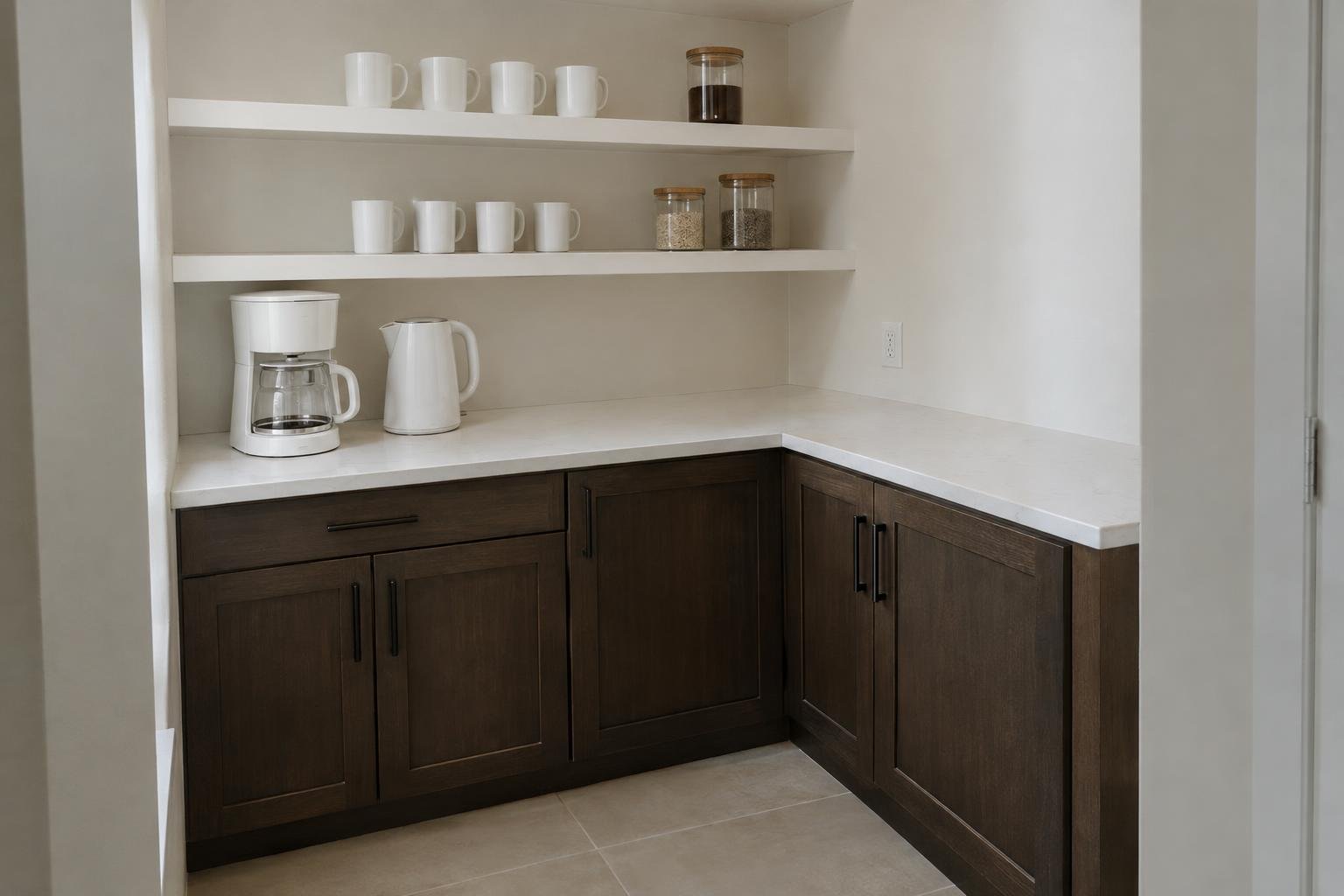
If the kitchen is tight, a walk-in pantry can host the entire setup and keep small appliances off the main counters. A dedicated counter inside the pantry gives you a landing zone for the grinder, brewer and kettle, with shelves above for mugs and supplies and base cabinets below for refills. The mess stays out of sight, and the main kitchen stays calm when guests are over.
The trade-off is distance from water and from the household’s traffic, so plan for it early. A pantry counter needs enough electrical capacity for several appliances, and many homeowners want a nearby outlet strategy that avoids running cords across the work surface. We cover shelving and layout choices in more depth in our guide to walk-in pantry design.
Plan Counter Space and Outlets Together
A coffee bar lives or dies on counter depth and power. Appliances such as espresso machines and grinders need room in front for a cup and often need clearance above for filling a water tank or opening a lid. We recommend laying out the actual equipment on the counter with tape or boxes before cabinetry is ordered, then confirming the upper shelf or cabinet underside leaves enough clearance.
Outlets deserve the same attention. Plan more receptacles than you think you need, spaced along the backsplash so cords reach without stretching. Many homeowners prefer a dedicated switch for a clock or a smart plug for the brewer. Electrical requirements vary by home and by jurisdiction, so we always suggest confirming the details with your contractor and your local building department. Placing outlets in the planning stage is far simpler than cutting into a finished backsplash later.
Think Through Water Access
Water is the detail that separates a coffee corner from a true coffee bar. Filling a carafe, rinsing a portafilter and emptying a drip tray all go faster with a sink within a few steps. Some households add a small prep or bar sink in the run, which means supply lines and a drain need to reach the spot. That is a plumbing decision with real implications in a home built on a slab, so it is worth discussing early.
If a second sink is not practical, locate the station within a short walk of the main sink and keep the path clear. Whichever route you take, look at water-efficient faucet options. The EPA WaterSense program labels water-efficient faucets, and its guidance is a useful starting point when you compare flow rates for a bar sink. Depending on your water supply, many homeowners also add a filtration step at the station, so leave room under the counter for it.
Use an Appliance Garage or Pull-Out for the Machines
Not everyone wants a brewer on display all day. An appliance garage is a cabinet section with a lift-up or sliding door that hides the machine while it sits on the counter. The machine stays plugged in and ready, so follow the appliance maker’s guidance on enclosing it. Check that the door clears the underside of the upper cabinets and that there is ventilation for heat and steam, since a closed compartment can trap moisture, which matters in our humid climate.
A pull-out shelf is another option. It lets a heavy espresso machine slide forward for use and slide back for storage, which saves the strain of lifting. For heavy equipment, the slide hardware should be rated for the load. Both approaches come from custom-built boxes, so they fit best when planned into the custom cabinetry design rather than added as an afterthought. If you are choosing a cabinet line, we are an authorized Fabuwood dealer and can walk you through the options. If you want a fuller beverage station with a sink and glassware storage, see our guide to a custom home bar and beverage center.
Design Storage for Pods, Beans and Mugs
Storage is what keeps the bar tidy in week three, not just on day one. Start by counting what you actually use: pods, filters, beans, syrups, tea, stir sticks and mugs. Then give each category a home sized to the quantity you keep.
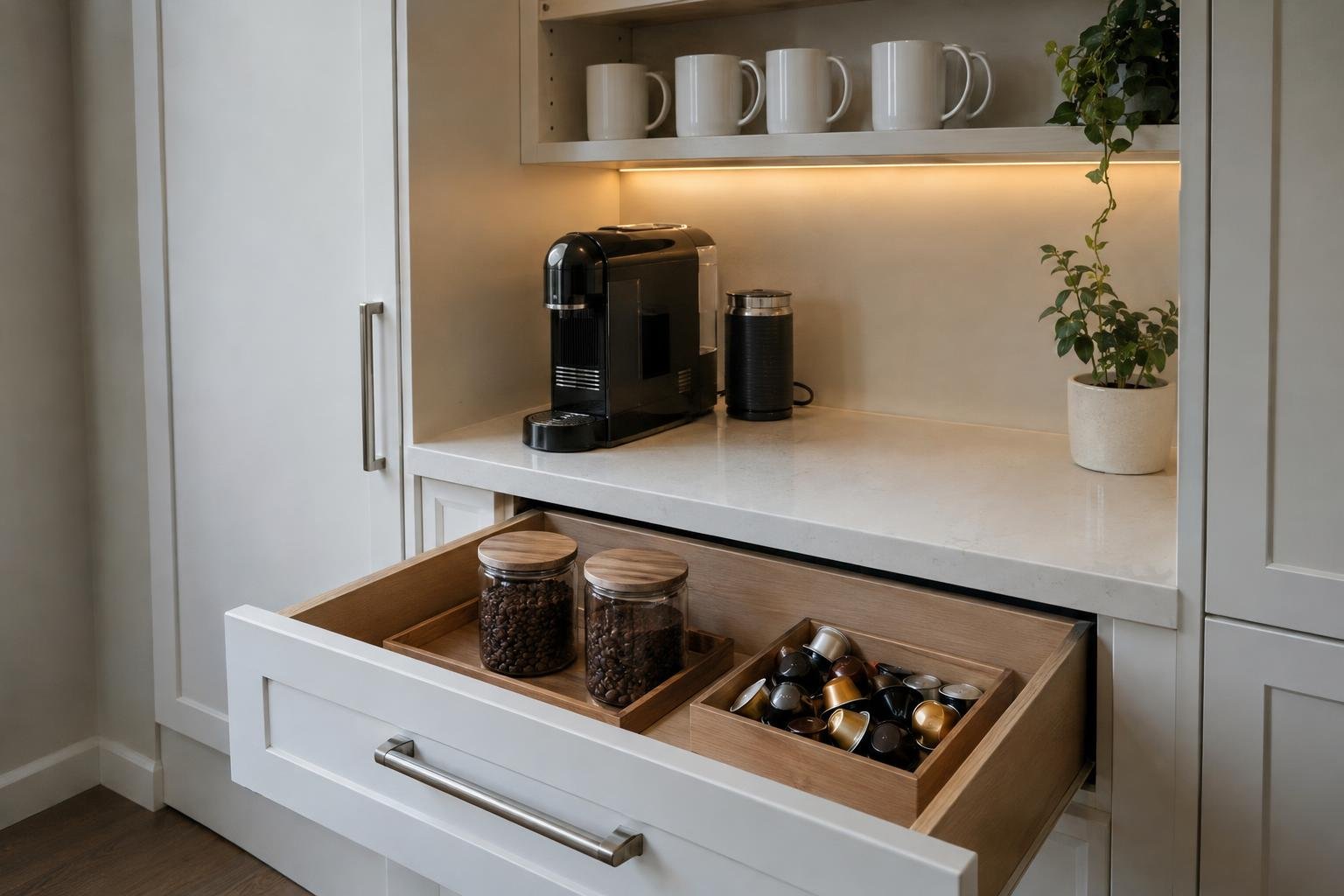
- Shallow drawers with dividers for pods and tea keep small items visible instead of buried.
- Open shelves or glass-front uppers display mugs and keep them within easy reach.
- A deeper drawer or a tall pull-out holds bulk bags of beans and refills.
- A small tray on the counter corrals sweeteners and spoons so they do not spread across the surface.
Keep daily mugs at a comfortable reach height and move guest sets higher. In a pantry setting, a shelf at the back of the counter can hold mugs and cups at eye level, like the arrangement shown below.
Light the Station and Protect the Splash Zone
Good lighting makes a coffee bar feel intentional. Under-cabinet lighting washes the counter in even light, which helps with measuring and pouring and highlights the backsplash. LED strips are common because they run cool and are easy to hide behind a cabinet rail. Test a sample before you commit to a color temperature.
The backsplash does real work here. Steam, drips and espresso splatter land on the wall behind the machine, so choose a surface that wipes clean and handles moisture. Large-format slabs and tight-grout tile both reduce the lines where residue collects. Carry the material high enough to cover the wall behind the equipment, and consider continuing it to the underside of the upper cabinets for a finished look.
Frequently Asked Questions
How much counter space does a coffee bar need?
It depends on your equipment, but a stretch wide enough for the machine, a grinder and a landing area for a cup is a sensible starting point. We lay out the real appliances before finalizing cabinetry.
Do I need a sink at the coffee station?
Not always. A sink nearby is helpful for filling and rinsing, but many stations work well within a short walk of the main sink. A second sink adds plumbing work, so we discuss it early in design.
Can a coffee bar be added to an existing kitchen?
Often, yes. A cabinet run can frequently be adapted, an adjacent wall can be opened, or a pantry can be fitted out, depending on where power and plumbing already exist. We review the space and talk through the options.
Will an appliance garage trap moisture in a humid climate?
It can if it is sealed tightly. We plan for ventilation and suggest letting the machine cool and dry before closing the doors, which is especially helpful in Southwest Florida.
If you are ready to build a coffee bar that works every morning, we are ready to help. Call (239) 771-2855 to request an estimate, or visit our kitchen remodeling page to see how we approach the whole room. We are a licensed Florida building contractor (CBC1268590).