
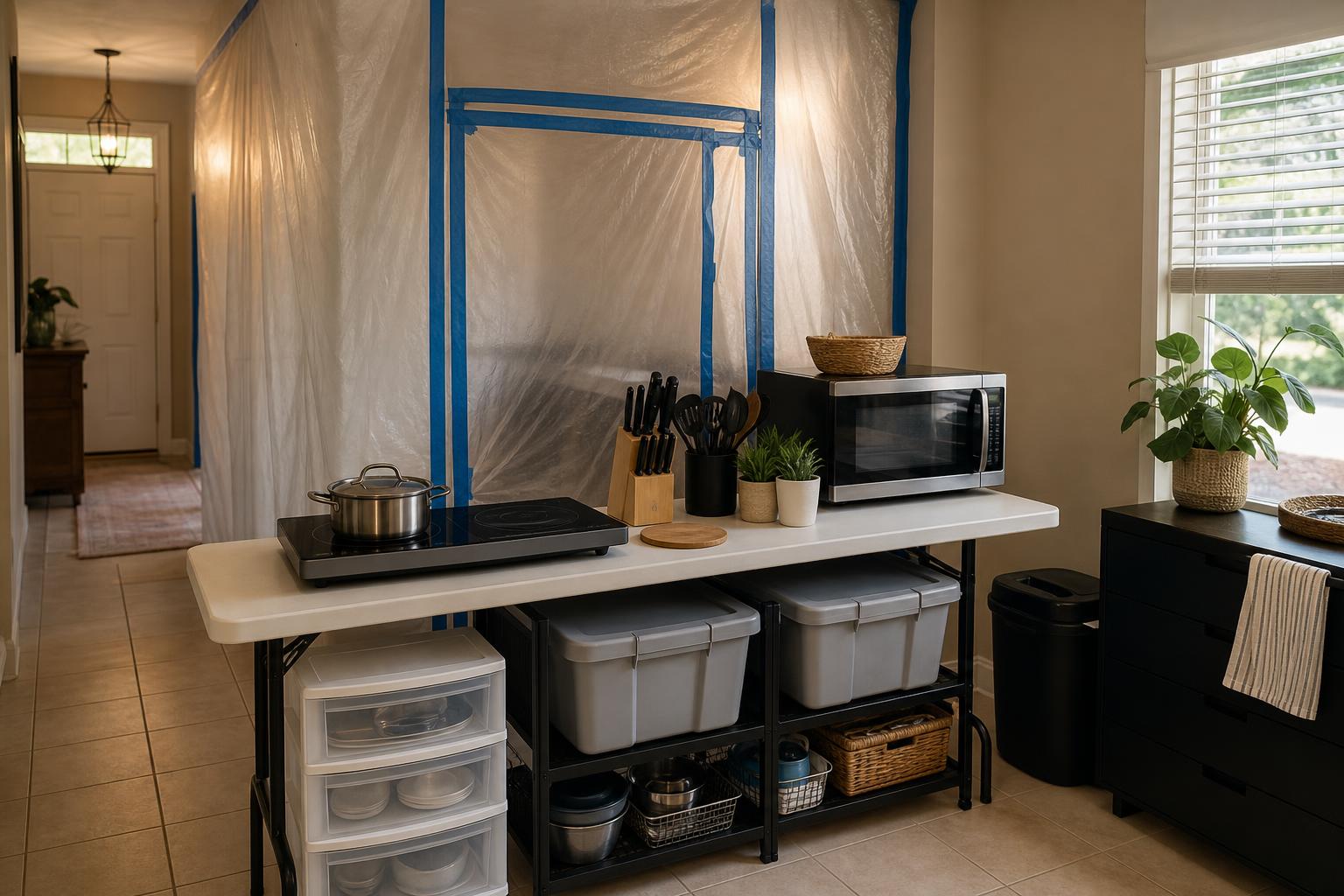
If you’re planning on living through a kitchen remodel in Fort Myers, you already know the kitchen is the most-used room in the house, and losing full access to it for four to eight weeks tests patience fast. Southwest Florida homeowners face a few extra wrinkles: year-round 70-plus percent humidity means dust and debris can settle into every corner and promote mold growth if containment barriers aren’t sealed well; snowbird schedules may compress your project window; and slab-on-grade construction common to mid-century CBS homes in Lee County can complicate under-floor plumbing re-routes, sometimes adding days to a timeline you’ve already planned around. This guide walks you through practical strategies (temporary kitchen setups, dust control, contractor scheduling, and daily routines) so you can stay comfortable at home while the work gets done right.
Set Up a Functional Temporary Kitchen Before Demo Day
The single best thing you can do before your contractor swings the first demo tool is establish a working temporary kitchen somewhere else in the house. A spare bedroom, dining room corner, or covered lanai can all serve this purpose if you plan ahead. The goal is simple: give yourself a surface to prep food, appliances to cook basic meals, and a clean water source so you’re not eating out for every meal, which adds up fast on a four-to-eight-week project budget.
Here’s what a practical temporary kitchen setup looks like for most SWFL homeowners:
- Counter space: A folding table or portable workbench gives you a prep surface. Cover it with a self-healing cutting mat or a sheet of melamine for easy cleanup.
- Cooking appliances: A two-burner induction cooktop ($60–$120) and a countertop convection oven or microwave handle 80 percent of weeknight cooking. Add a small coffee maker and you’ve covered most mornings.
- Refrigeration: If your existing refrigerator can be relocated to the garage, do it. SWFL garages run hot (often above 90°F in summer) so a refrigerator there will work harder and use more energy, but it’s temporary. A small secondary mini-fridge in the living area works well for daily-use items.
- Dishwashing: A utility sink in the laundry room becomes your best friend. Stock it with a dish tub, a drying rack, and a bottle of dish soap. If you have a bathroom vanity with counter space, paper plates and compostable bowls cut down on dishwashing entirely.
- Water access: Contractors will shut off kitchen water during rough-in plumbing phases. Know in advance which bathroom or utility sink stays live so you’re never without a water source.
Setting this temporary station up two or three days before demolition starts gives you time to test it out and identify gaps before you’re dependent on it. A licensed Florida general contractor will typically give you a day-by-day schedule so you can anticipate which utilities go offline and when.

Understand the Remodel Timeline So Nothing Catches You Off Guard
One of the biggest sources of stress for homeowners living through a kitchen remodel isn’t the noise or the dust; it’s the uncertainty. When you understand what happens in each phase, you can plan your own schedule around the high-disruption days and relax during the lower-impact ones.
A typical kitchen remodel in Fort Myers follows this general sequence:
- Permitting (1–3 weeks before demo): Lee County permit timelines vary, but residential kitchen permits for electrical and plumbing work generally take one to two weeks for straightforward projects. Work with a contractor who pulls permits; it protects your homeowner’s insurance and your resale value.
- Demolition (Days 1–3): The loudest, dustiest phase. Cabinets, countertops, and flooring come out. If your home has slab-on-grade plumbing (common in mid-century CBS construction throughout Cape Coral and Lehigh Acres) your contractor may need to saw-cut the slab during this window to re-route supply or drain lines, adding a day or two.
- Rough-in work (Week 1–2): Plumbing, electrical, and HVAC rough-in happens after demo. Expect some daily disruption but less total noise. Inspections from Lee County building department occur here.
- Drywall and tile (Week 2–3): More dust, though less intense. Ceramic or porcelain tile work is common in SWFL kitchens because it stands up to year-round AC condensation cycles and high humidity.
- Cabinet installation (Week 3–4): Semi-custom cabinet deliveries must arrive on schedule; delays push everything downstream. Confirm lead times: semi-custom cabinets typically run three to six weeks; custom cabinets eight to twelve weeks.
- Countertop template and install (Week 4–5): Quartz, granite, and porcelain slab countertops are templated after cabinets are set, then fabricated and installed within one to two weeks typically.
- Finish work and final inspection (Week 5–8): Appliance installation, trim, backsplash, hardware, and punch list. Final inspection with Lee County closes the permit.
Sharing this schedule with everyone in your household (including kids and anyone working from home) lets people plan around the disruptive phases. Our kitchen remodeling services include a written project schedule so you always know what’s happening next.
Control Dust and Humidity to Protect Your Home
Dust control during a kitchen remodel isn’t just about comfort: in Southwest Florida’s climate, it’s a genuine health and property concern. Year-round humidity averaging above 70 percent means fine construction dust that settles on surfaces and mixes with moisture can become a substrate for mold within 24 to 48 hours if it’s not cleaned up and dried out. Drywall dust, wood particulate, and thinset are all hygroscopic; they absorb ambient moisture readily.
Containment Barriers and Negative Pressure
A professional crew should install heavy-duty poly sheeting (6 mil minimum) at every doorway and opening connecting the kitchen to the rest of the living space. Zipper-door barriers on high-traffic pass-throughs allow access without compromising the seal. For larger projects, a negative-pressure air scrubber positioned at the kitchen exterior door or window (venting dust-laden air outside) dramatically reduces what migrates to the rest of the house. Ask your contractor specifically about this practice before the project starts.
HVAC Protection
Close and tape over every supply and return air register in the kitchen during demolition and drywall phases. Fine drywall dust pulled into a return can coat evaporator coils and reduce airflow, which is a real problem when your AC runs continuously in Southwest Florida. Consider changing your air handler filter more frequently: every two to three weeks during active construction rather than the standard monthly interval. A ENERGY STAR-rated air handler with a MERV 11 or higher filter will capture finer particulates if you’re running the system during light-work phases.
Daily Cleanup Standards
Set a clear expectation with your contractor: the work area gets broom-swept and loose debris bagged daily before the crew leaves. Wet-mopping the subfloor or concrete slab every two to three days during dusty phases keeps particulate from migrating. In Fort Myers, exterior dumpsters fill quickly in summer heat: confirm your contractor has a dumpster or haul-away schedule that keeps debris from sitting on your driveway for days at a time.

Manage Noise, Access, and Your Household Routine
Construction noise during a kitchen remodel is unavoidable, but it’s manageable when you understand the schedule and set ground rules with your contractor upfront. In Fort Myers and throughout Lee County, local ordinances generally restrict construction noise to daytime hours, typically 7:00 a.m. to 7:00 p.m. on weekdays. Most professional crews work 7:00 a.m. to 4:00 or 5:00 p.m., giving you quiet evenings.
The loudest days are demolition (Days 1–3) and saw-cutting for slab plumbing if needed. If you work from home or have young children who nap, identify those peak-noise windows in advance and plan to be out of the house, work from a library or coffee shop, or schedule calls accordingly. High-quality noise-canceling headphones are worth the investment for a four-to-eight-week project.
Access logistics matter, too. Establish clear expectations about:
- Entry and exit: Which door does the crew use? Front door, garage, or side gate? Keeping crew traffic away from your main living areas reduces disruption.
- Material staging: Where do cabinets, appliances, and tile boxes stage before installation? A two-car garage works well; a covered lanai is a secondary option as long as materials stay dry in SWFL’s afternoon storm season.
- Pets: Dogs and cats should be secured or relocated on high-traffic days. Open exterior doors during delivery days create escape routes and safety hazards around power tools.
- Work-hour boundaries: Confirm start and stop times. A quality general contracting team respects household boundaries and communicates about early arrivals or overtime days in advance.
If your project falls during SWFL’s summer rainy season (June through September) afternoon thunderstorms can affect delivery schedules and outdoor work. Build a two-to-three-day weather buffer into your mental timeline, especially if your project touches any exterior openings.
Budget for Living Costs and Protect Against Scope Surprises
Living through a kitchen remodel has real carrying costs beyond the renovation budget itself. Most Fort Myers households spend $300 to $600 more per month on food and convenience items during a remodel: between partial restaurant meals, premium grocery items that don’t require cooking, and disposable dinnerware. Build that into your project budget from the start rather than treating it as an unexpected expense.
Scope surprises are the other budget reality. In Southwest Florida, older CBS homes (particularly those built between the 1960s and 1990s in Cape Coral, Punta Gorda, and North Fort Myers) frequently reveal hidden issues when walls open up: outdated knob-and-tube or aluminum branch wiring, cast-iron drain lines that have corroded through, or water damage around slab penetrations that’s been slow-leaking for years. A thorough pre-construction walkthrough with your contractor, including inspection of the electrical panel, reduces but doesn’t eliminate surprises.
Reserve 10 to 15 percent of your total project budget as a contingency. If your kitchen remodel is budgeted at $45,000, keep $4,500 to $6,750 in reserve. For permit-pulled, code-compliant work through a licensed Florida general contractor, the general contracting process includes proper subcontractor coordination and inspection sequencing, which protects you from cost cascades caused by out-of-sequence work.
Salt-air corrosion is another factor for homes within five miles of the Gulf, particularly in Naples, Bonita Springs, and Estero. Hardware, fixtures, and appliance connections in coastal kitchens corrode faster than inland homes. Specify stainless steel or marine-grade hardware and verify that any gas line connections use fittings rated for coastal environments. These are details a locally experienced contractor will flag; a contractor unfamiliar with SWFL conditions may not.
Frequently Asked Questions
How long will I be without a working kitchen in Fort Myers?
For a full kitchen remodel, expect to rely on your temporary kitchen setup for four to eight weeks total. The first one to two weeks tend to be the most disruptive: demolition, rough-in plumbing, and electrical. By weeks three and four, work shifts to cabinet installation and finish trades, and daily disruption drops significantly. Permitting timelines in Lee County can add one to three weeks before physical work begins, so factor that into your planning.
Can I stay home during demolition, or should I leave?
You can stay home during demo, but many homeowners choose to be out of the house for the first one to two days when noise and dust are at their peak. If you have respiratory sensitivities, young children, or pets, making arrangements to be elsewhere during demolition and any slab saw-cutting is a reasonable choice. A well-organized crew with proper dust containment makes staying home feasible for most people during all other phases.
Will the remodel affect my air conditioning system?
Construction dust (especially drywall dust) can clog air filters and coat evaporator coils if your HVAC system runs unprotected during the remodel. Tape over kitchen supply and return registers during dusty phases, increase filter change frequency to every two to three weeks, and have your system checked after project completion. In Southwest Florida, where AC runs year-round, keeping your system clean during construction is worth the extra attention.
What’s the best way to communicate with my contractor during the project?
Establish a preferred communication method before work starts: text, email, or a daily end-of-day briefing. Request a written schedule with key milestones so you can track progress against the plan. Identify a single point of contact on the crew, typically the project superintendent, for daily questions. For larger decisions (material changes, discovered issues, scope additions) ask for written change orders with cost and schedule impacts before approving any changes.
Ready to plan your kitchen renovation without the guesswork? Alliance Construction & Renovation is a licensed Florida general contractor serving Fort Myers, Cape Coral, Naples, and the surrounding Lee, Collier, and Charlotte county area. We pull permits, coordinate every trade, and give you a clear project schedule before the first tool comes out. Call us at (239) 771-2855 to schedule a consultation, or explore our kitchen remodeling services to see how we approach projects from planning through final inspection.