
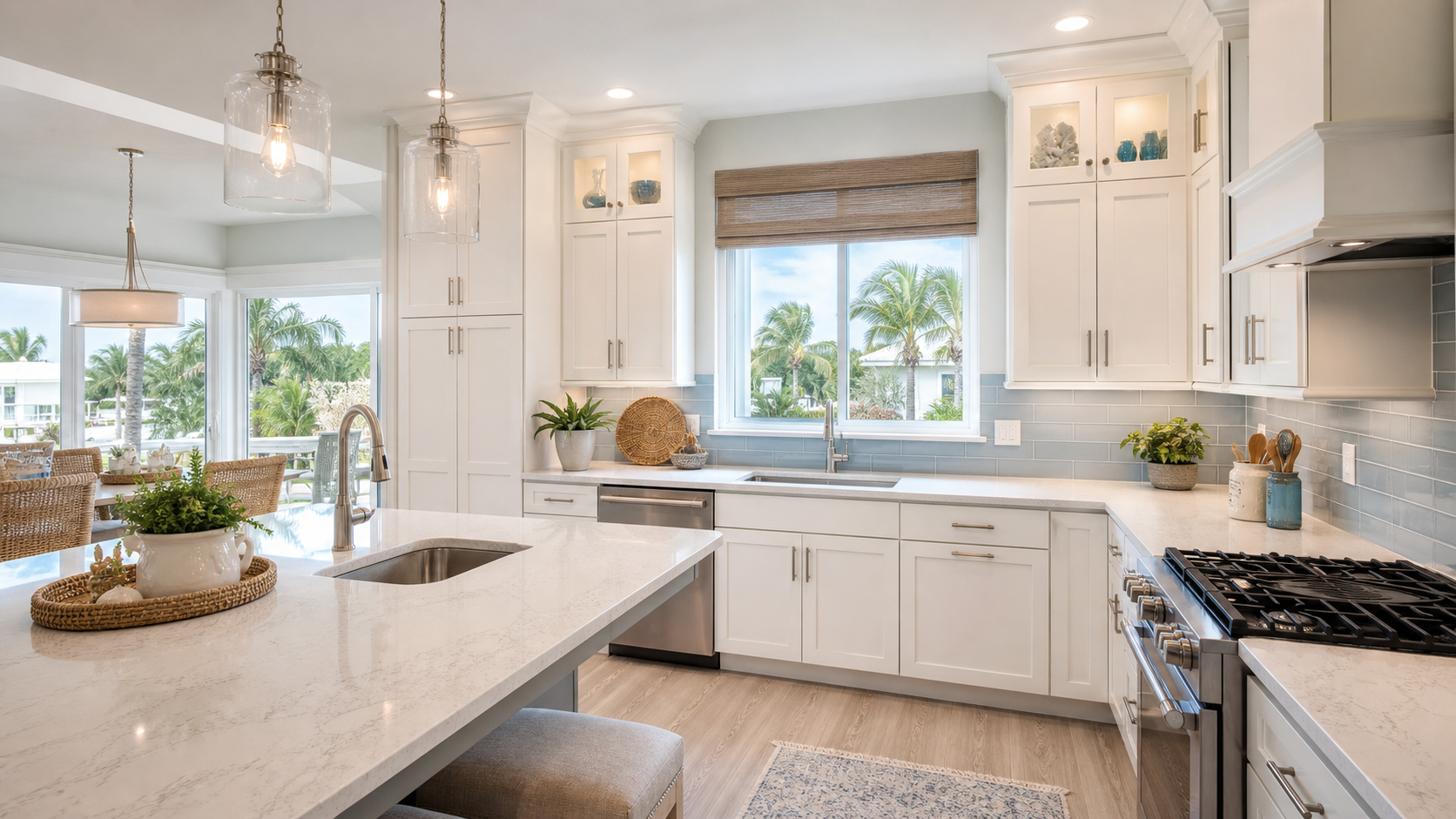
Choosing the right coastal cabinet styles for Fort Myers homes involves more than picking a color from a brochure. Southwest Florida’s combination of year-round 70%+ humidity, salt-air exposure within five miles of the coast, and intense UV light creates a demanding environment that exposes every weakness in a cabinet’s construction, finish, and hardware. Whether you’re updating a mid-century concrete-block (CBS) ranch in Cape Coral or finishing a new kitchen in a Bonita Springs waterfront build, the cabinet style you select will shape how your space feels, and how well it holds up through hurricane seasons and decades of coastal living. This guide walks you through the most popular cabinet profiles, finish strategies, material choices, and color directions that actually work in SWFL conditions.
Understanding Why Coastal Conditions Change Your Cabinet Choices
Fort Myers and the surrounding Lee County area sit in a climate zone that punishes the wrong building materials quickly. Indoor relative humidity rarely drops below 65% even with year-round AC operation, and in homes left vacant during the summer months (a common pattern for snowbird owners) moisture levels can climb significantly higher. That level of ambient humidity causes solid-wood face frames and doors to expand, cup, and eventually crack finishes if the wood isn’t properly acclimated and sealed.
Salt air compounds the problem. Homes within five miles of the Gulf, Pine Island Sound, or the Caloosahatchee River experience accelerated oxidation on exposed metal surfaces. Standard steel hinges and drawer slides that work fine in an inland kitchen can show surface rust within 12–18 months in a coastal kitchen. For that reason, specifying stainless steel or marine-grade hardware, or powder-coated aluminum drawer slides rated for high-humidity environments, is standard practice in quality SWFL cabinet installations.
The current Florida Building Code also has indirect effects on your cabinetry project. If your renovation triggers a permit (which it will for any structural wall removal, electrical upgrade, or plumbing relocation in a kitchen) the inspector will expect the overall installation to meet current code. Working with a licensed Florida general contractor who pulls permits through Lee County ensures your project is documented, which matters at resale and for insurance purposes. Lee County permit timelines for kitchen remodels typically run two to four weeks for residential work, so factoring that into your project schedule is essential.
Finally, slab-on-grade construction (the standard foundation for virtually every home in Fort Myers and Cape Coral) means your lower cabinet runs sit close to a concrete floor that can wick moisture upward. Specifying toe-kick areas with a moisture-resistant finish and ensuring the base cabinets are set on a leveled, sealed substrate protects the cabinet box from the ground up.
Shaker, Slab, and Raised Panel: Which Profile Fits Coastal Fort Myers Homes
Cabinet door profiles fall into three broad families, and each carries different practical and aesthetic implications for a coastal setting.
Shaker Style
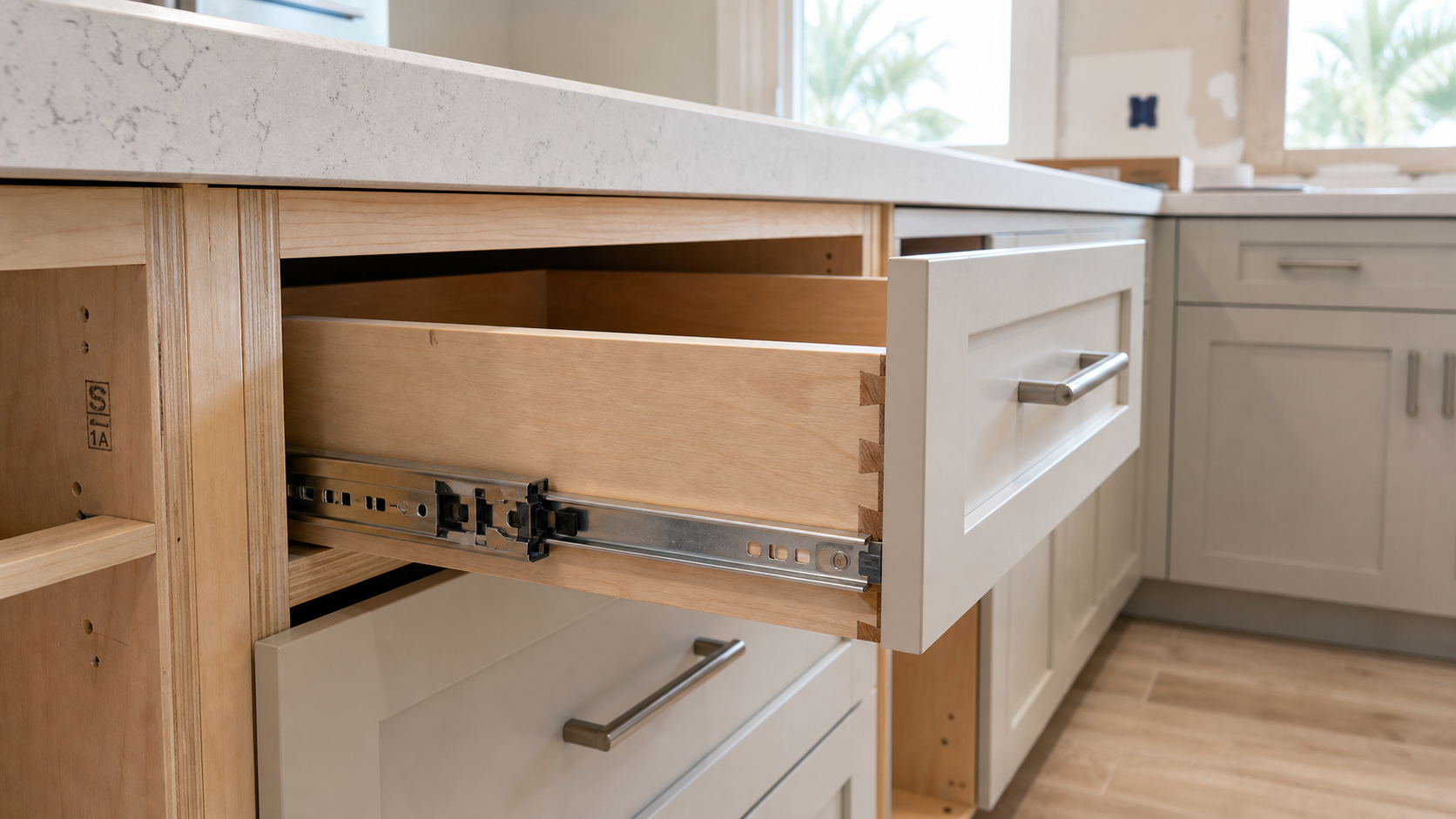
The five-piece Shaker door (a flat center panel framed by four square-edged rails and stiles) is the dominant choice in Southwest Florida renovations right now, and for good reason. Its clean lines read as both casual and refined, fitting the relaxed aesthetic most Fort Myers homeowners want. More practically, the recessed center panel has fewer ornate crevices to trap humidity or dust, making it easier to clean and maintain. When built with MDF center panels (medium-density fiberboard) inside a solid or engineered wood frame, a Shaker door resists seasonal panel movement better than a fully solid-wood door. Semi-custom lines from manufacturers like Kraftmaid or Wellborn offer moisture-resistant MDF options specifically recommended for coastal and high-humidity climates. Custom shops can build the same profile in all-plywood box construction with dovetail drawer boxes, which is worth the premium in a humid coastal environment.
Slab Style
A slab door is a single flat panel with no framing details. It photographs well in contemporary and transitional coastal interiors (think a Naples waterfront condo or a new build in Estero) and it’s the easiest profile to wipe down completely. The trade-off is that a large flat slab is more susceptible to visual warping if the substrate isn’t perfectly stable, and any dent or ding is more visible without the shadow line of a frame. Slab doors in a thermofoil or rigid UV-cured lacquer finish on an MDF core perform well in SWFL humidity and are a practical choice where budget and maintenance simplicity are priorities.
Raised Panel Style
Raised panel doors, with their contoured center panel that sits proud of the frame, read as more traditional and formal. They appear frequently in older Fort Myers and Cape Coral homes built in the 1990s and early 2000s. While architecturally appropriate in those settings, raised panel profiles collect more dust and grime in Florida’s environment and tend to show humidity-related finish cracking at the panel-to-frame junction over time. If you’re staying with or refreshing a raised-panel look, a quality paint-grade maple with a catalyzed conversion varnish topcoat and a full perimeter bead of flexible caulk at the panel joint will extend finish life considerably.
Material and Construction Standards That Hold Up in SWFL Humidity
The style of a cabinet door matters far less than the quality of what’s behind it. In a Fort Myers kitchen that runs its air conditioning year-round but may still see brief humidity spikes during summer, the cabinet box construction is the component most likely to fail first if specified incorrectly.
Plywood box construction is the right call for coastal homes. A ¾-inch, furniture-grade plywood box with a moisture-resistant (MR) or exterior-grade core is substantially more stable than a particleboard box when humidity fluctuates. Particleboard swells when it absorbs moisture and does not fully recover: once it begins to delaminate at the toe kick or under the sink cabinet, the structural integrity of the whole run is compromised. The under-sink base cabinet is the highest-risk location in any kitchen and deserves particular attention: specify a plywood box, add a stainless-steel or plastic drip tray, and use a semi-gloss or gloss interior finish that can be wiped down quickly if a supply line ever drips.
Dovetail drawer boxes in solid wood or Baltic birch plywood are the standard for quality work. Paired with full-extension, soft-close undermount slides (Blum Tandem and Grass Nova Pro are reliable options) they provide smooth operation and resist the warping that can cause cheaper slides to bind during humid months. Hardware finishes that perform well in coastal environments include brushed stainless steel, oil-rubbed bronze with a sealed topcoat, and matte black powder coat. Avoid unlacquered brass or chrome in high-salt-air zones unless you’re committed to regular polishing.
For custom cabinetry in Fort Myers, local shops can source plywood with exterior-grade glue lines and apply finish systems specifically formulated for the Florida market: a detail that matters when you’re choosing between semi-custom and fully custom work.
Color and Finish Trends for Coastal Southwest Florida Kitchens
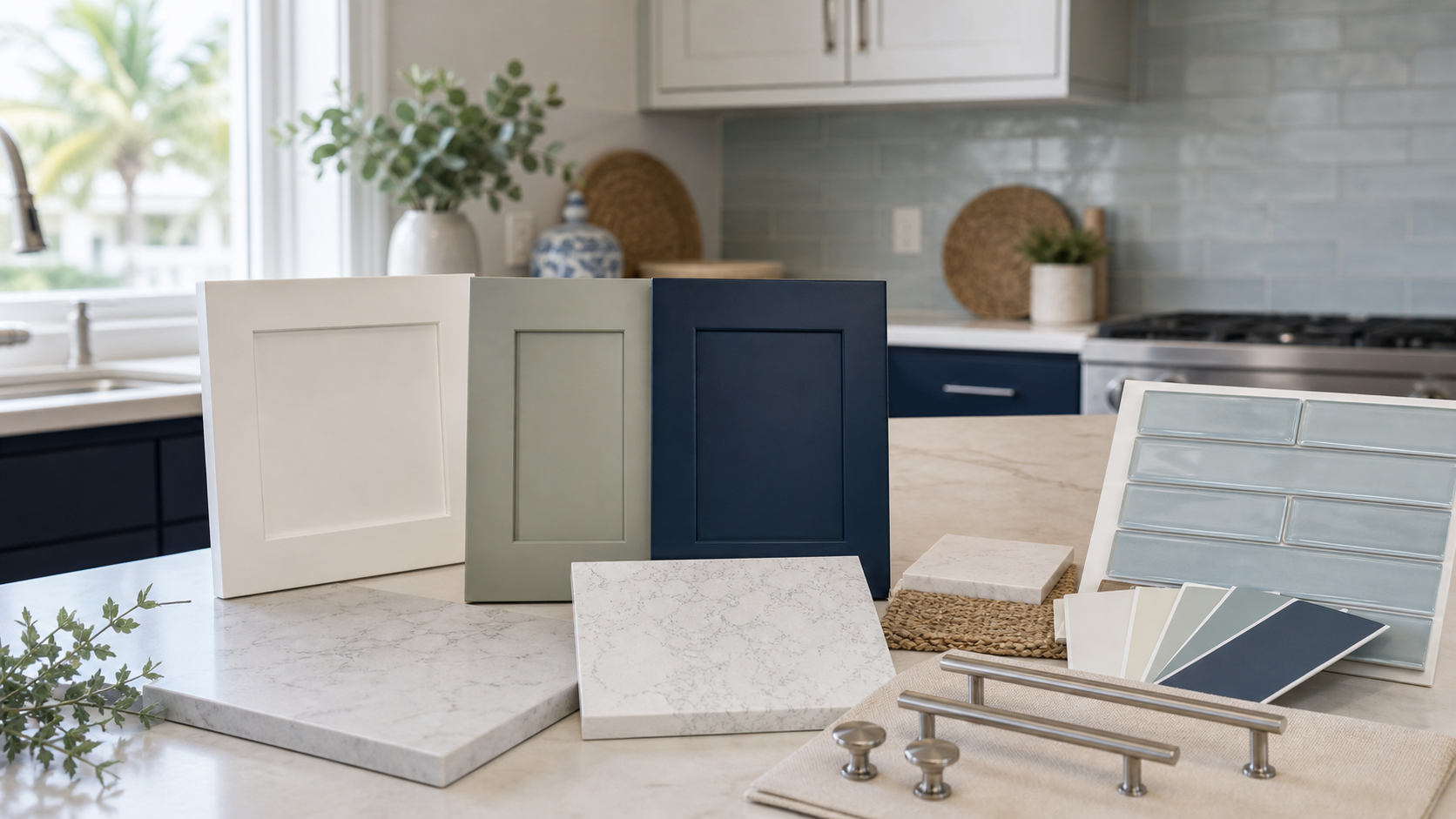
Paint color and finish choice in Fort Myers kitchens in 2024–2025 reflects a broader shift away from all-white toward more layered, relaxed palettes that complement the Gulf Coast light. That said, white and off-white cabinets remain popular because they reflect light well in interiors that may have limited north-facing window exposure: a common condition in homes oriented for hurricane impact window placement rather than light optimization.
The color directions gaining traction in SWFL renovations right now include:
- Warm whites and creamy off-whites (Benjamin Moore White Dove, Sherwin-Williams Alabaster): the most forgiving finish for showing less dust and fingerprints than a stark true white.
- Soft sage green and muted eucalyptus: a natural coastal complement to quartz countertops in warm grays or veined whites.
- Navy and slate blue lower cabinets with white uppers: a two-tone approach that grounds the kitchen visually and hides scuffs better on base cabinets.
- Warm greige and taupe: works particularly well in CBS homes with tile floors and neutral porcelain or travertine surrounds.
Finish durability matters as much as color. For painted cabinets, a catalyzed lacquer or conversion varnish applied in a controlled shop environment outperforms a field-applied latex paint in terms of hardness, moisture resistance, and cleanability. A semi-gloss or eggshell sheen is the practical choice: high-gloss shows every smear and surface imperfection, and flat finishes are too porous for a kitchen environment. For stained natural wood, a UV-resistant topcoat protects against the intense Southwest Florida sun that enters through large impact-glass sliders and windows.
Natural wood tones in white oak, light maple, and warm walnut are also appearing more frequently in Fort Myers kitchen remodels as a counterpoint to the painted-cabinet trend, often as an island accent or open-shelf section rather than a full-kitchen treatment. According to NAHB design trend data, mixed-finish kitchens combining painted perimeter cabinets with a natural-wood island have been one of the most consistent preferences in remodeling surveys over the past three years.
Layout Considerations Specific to Fort Myers and Cape Coral Homes
Cabinet style decisions don’t happen in isolation: the layout of your kitchen directly influences which door profiles and configurations make practical sense. Fort Myers and Cape Coral homes built between the 1960s and 1990s often feature galley or L-shaped kitchens in modestly sized footprints, sometimes opening toward a screened lanai or pool deck. That indoor-outdoor connection is a defining feature of coastal Florida living, and the cabinet plan should acknowledge it.
If your kitchen opens to a lanai through large impact-glass sliding doors, consider how the cabinet finishes read from both sides. A dark lower cabinet that looks sophisticated inside can read as heavy when seen from a bright outdoor space. Lighter uppers or open floating shelves near the transition point soften that visual boundary. Open shelving in a coastal kitchen, however, should be approached with realistic expectations: in a high-humidity, year-round-AC environment, items stored on open shelves accumulate fine dust from AC systems and require regular cleaning.
For a kitchen remodel in Fort Myers or Cape Coral, the typical project timeline runs four to eight weeks from cabinet delivery to final walkthrough, depending on scope. That estimate accounts for countertop template and fabrication (usually 10–14 days for quartz or granite after cabinet installation), plumbing reconnection, and finish electrical. Extended lead times on semi-custom or custom cabinet orders (currently running eight to fourteen weeks from most manufacturers) mean the ordering decision needs to happen early in the design process, well before demolition begins.
Pantry cabinets and tall utility columns are increasingly in demand as Fort Myers homeowners work to maximize storage in existing footprints rather than pushing into adjacent rooms. Full-height pantry runs with pull-out shelving, lazy Susans at corner transitions, and drawer-heavy base cabinets (rather than the traditional door-and-shelf base) all improve functionality in a kitchen that may host extended family during winter months and need to operate efficiently under heavy use.
Frequently Asked Questions
What cabinet material holds up best in a humid Fort Myers home?
Plywood box construction with a moisture-resistant core is the most durable choice for Southwest Florida kitchens. It outperforms particleboard and MDF boxes in high-humidity environments because it resists swelling and delamination. For door panels, MDF center panels inside a solid or engineered wood Shaker frame provide good stability. Pair everything with marine-grade or stainless-steel hardware to minimize corrosion in salt-air zones near the Gulf.
Are semi-custom cabinets good enough, or do I need fully custom cabinetry for a coastal kitchen?
Semi-custom cabinets from quality manufacturers work well in standard kitchen layouts and offer finishes specifically rated for high-humidity climates. Fully custom cabinetry makes sense when your layout involves unusual dimensions, specific wood species, or specialty storage configurations that standard lines can’t accommodate. Both options can be executed correctly: the bigger factor is working with an experienced installer who understands Florida’s climate requirements and pulls the proper permits through Lee County.
How much does a kitchen cabinet replacement typically cost in Fort Myers?
Cabinet-only replacement in a mid-sized Fort Myers kitchen (roughly 150–200 square feet) typically runs $8,000–$18,000 for semi-custom, and $18,000–$40,000 or more for fully custom work, depending on door style, finish, and hardware. Full kitchen remodels including countertops, backsplash, and plumbing run $35,000–$80,000 for most SWFL homes. These figures reflect current Lee County material and labor pricing and will vary based on scope and site conditions.
Do I need a permit to replace kitchen cabinets in Cape Coral or Fort Myers?
A straight cabinet swap (removing old cabinets and installing new ones without moving plumbing, electrical, or structural walls) generally does not require a permit in Lee County or Cape Coral. However, if your project includes relocating a sink, adding circuits, removing a wall, or changing the layout footprint, permits are required. A licensed Florida general contractor can evaluate your specific project scope and advise on permit requirements before work begins.
Ready to move forward on your kitchen or cabinet project? Alliance Construction & Renovation is a licensed Florida general contractor serving Fort Myers, Cape Coral, Naples, Bonita Springs, and the surrounding SWFL area. Our team handles permit-pulled work from design through final inspection, with real knowledge of coastal construction conditions specific to Lee, Collier, and Charlotte counties. Call us at (239) 771-2855 to schedule a consultation, or visit our kitchen remodeling page to learn more about how we approach coastal kitchen projects from the ground up.