
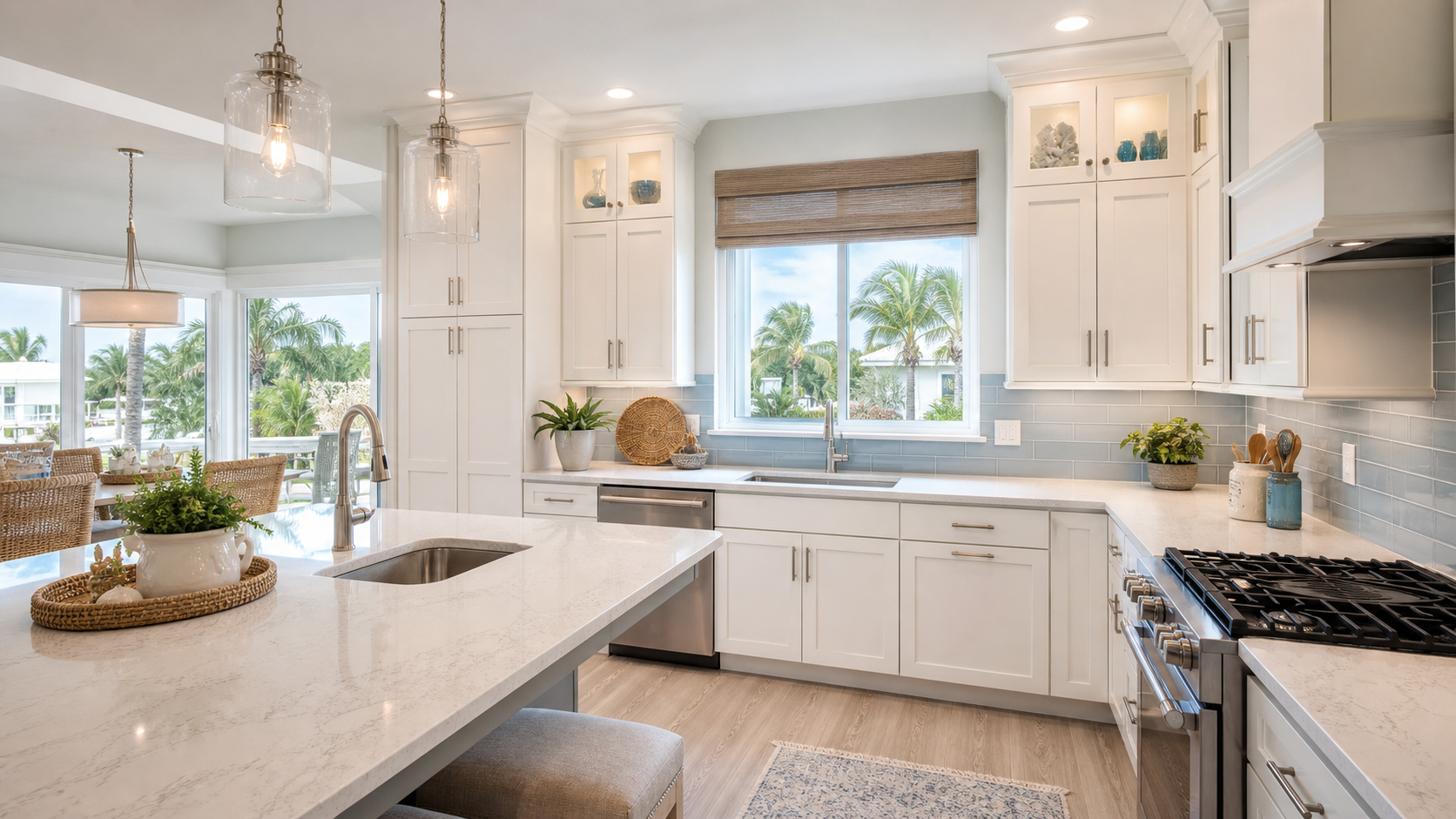
A pantry conversion in a Fort Myers kitchen can completely change how a tight space feels and functions, without a full addition or gut renovation. Many SWFL homes built in the 1970s through early 2000s were designed with minimal kitchen storage, reflecting an era when grocery runs were frequent and pantry space was an afterthought. Today, with families stocking up before hurricane season, managing busy household schedules, and hosting snowbird guests for months at a time, that storage shortfall becomes genuinely painful. This guide walks you through the most practical pantry conversion strategies for compact Fort Myers kitchens: converting underused closets, building butler pantry nooks, installing pull-out cabinet systems, and solving the stubborn corner cabinet problem. By the end, you will know what each approach costs, what it requires structurally, and which option fits your floor plan.
Assessing Your Kitchen Layout Before Any Pantry Conversion
Before you pull a single cabinet off the wall, spend time measuring and mapping your existing kitchen. In Fort Myers and across Lee County, the majority of homes in Lehigh Acres, Cape Coral, and older Fort Myers neighborhoods are built on slab-on-grade concrete foundations with concrete-block (CBS) construction. That matters for pantry conversions because you cannot cut into a bearing CBS wall without engineering review, and plumbing lines embedded in the slab dictate where you can and cannot reposition cabinetry or appliances.
Start by identifying which walls are load-bearing versus partition walls. In a CBS home, exterior walls are almost always structural; interior partition walls may not be, but you need a licensed contractor or structural engineer to confirm before you open anything up. Next, note where your existing water lines, drain lines, and electrical circuits run. Fort Myers’s slab-on-grade plumbing means supply and drain lines often enter the kitchen from below: relocating them costs $800–$2,500 depending on distance and complexity, and requires a permit from Lee County.
Map your “dead zones”: the corners, the narrow wall beside the refrigerator, the awkward 18-inch gap between the range and the doorframe. These dead zones are exactly where pantry storage gets reclaimed in small kitchens. A professional kitchen designer or kitchen remodeling contractor can produce a measured floor plan that shows you to-the-inch how much linear cabinet space is recoverable. In a typical 150–200 square foot Fort Myers kitchen, reclaiming even 24–36 inches of wall space can add 20–30 cubic feet of organized pantry storage.
Also factor in Florida’s climate. Year-round humidity in Southwest Florida runs at 70 percent or higher for much of the year, and kitchens trap moisture from cooking and dishwashing. Any enclosed pantry space needs ventilation (either a louvered door, a small passive vent, or an extension of your HVAC system) to prevent mold growth on shelves and packaged goods.
Closet-to-Pantry Conversions: Getting the Most Square Footage
The single highest-return pantry conversion in a tight SWFL kitchen is converting an adjacent closet (a hall closet, a coat closet, or a former utility closet) into a dedicated walk-in or reach-in pantry. If you have even a 24-inch-deep, 36-inch-wide closet within six feet of your kitchen, the conversion is worth investigating seriously.
A reach-in pantry conversion in an existing closet typically costs $1,500–$4,500 depending on whether you add custom shelving, pull-out drawers, and a new door or simply install wire or wood-plank shelving. A true walk-in pantry conversion (if you have a 5-by-5-foot or larger adjacent space) runs $4,000–$9,000 fully fitted out with solid shelving, task lighting, and an interior outlet for a small appliance like a coffee maker.
For the door, a barn-style sliding door is popular in Fort Myers renovations because it does not require swing clearance: critical when the pantry opening faces a narrow kitchen aisle. Pocket doors are another option but require framing modification and are harder to re-access if the hardware fails. A standard hinged door works in spaces where the swing zone is clear.
Shelving materials matter in Florida’s humidity. Solid wood shelves can sag and warp; moisture-resistant melamine-coated MDF or plywood with a laminate face holds up far better. Wire shelving is affordable and lets air circulate but can be awkward for small jars and bags. For a polished look that functions well in humid conditions, paint-grade plywood with a moisture-barrier primer coat is a reliable choice. Shelf depths of 12–16 inches work for most dry goods; deeper than 18 inches tends to create inaccessible back zones.
One important code note: if the closet conversion requires relocating an electrical outlet or adding lighting, permit requirements should be confirmed before work starts. Permit-pulled work can protect resale value and may help avoid inspection or insurance complications; ask your contractor, local building department, and insurance carrier how your specific scope should be handled.
Butler Pantry Nooks and Pass-Through Designs
If you do not have an adjacent closet to convert, a butler pantry nook carved from a dead-end wall section or a pass-through corridor between kitchen and dining room is the next best option. Butler pantries were common in early 20th-century construction and have returned in popularity: in SWFL, they are especially practical for snowbird households that arrive in November with months of supplies and need organized staging space separate from the main kitchen.
Open Nook Conversions
An open nook is the simplest approach: install upper and lower cabinets plus a short countertop section in a widened alcove or dead-end bump-out. The countertop can serve as a baking station, appliance landing zone, or beverage bar. Cost range is $3,500–$8,000 for semi-custom cabinetry, countertop (quartz or butcher block are popular here), and installation. Because this approach stays within the existing footprint, permit requirements are typically limited to electrical if you add an outlet or under-cabinet lighting.
Enclosed Pass-Through Butler Pantry
A more involved option is to frame a short corridor between kitchen and dining room (usually 5–8 feet long and 36–42 inches wide) with upper cabinets on both sides and a counter running through the middle. In current Florida Building Code terms, this is treated as interior remodeling work; it does require a permit if walls are moved or electrical is modified. Budget $8,000–$18,000 for a fully framed, fitted, and finished butler pantry corridor, which includes cabinetry, countertops, lighting, and paint. On a per-square-foot basis, butler pantry additions run $150–$250/sq ft finished.
Appliance Garages and Upper-Cabinet Pantry Towers
Not every kitchen has corridor space. An appliance garage (a tambour-door or hinged-door upper-cabinet extension that reaches from countertop to ceiling) can add 10–14 cubic feet of enclosed pantry-style storage with no structural work. Pantry tower cabinets (84-inch or 96-inch tall units) installed in a single-wide space beside the refrigerator or at the end of a run are another efficient solution. For custom sizing that fits exactly, explore custom cabinetry options that can be built to non-standard dimensions common in older Fort Myers and Cape Coral homes.

Pull-Out Systems and Cabinet Retrofits for Existing Kitchens
Not every household is ready for a full pantry conversion project. If your timeline or budget is limited, upgrading your existing cabinets with pull-out pantry systems can recover significant usable storage without demolition or permits.
Full-extension pull-out shelves installed inside base cabinets convert a single 24-inch-wide base cabinet into the functional equivalent of a pantry drawer stack. Full-extension undermount slides rated for 75–100 lbs are the standard for kitchen use. A set of three pull-out shelves for a 24-inch base cabinet costs $250–$600 in materials, with another $150–$300 in installation labor if you hire out the work. For a 36-inch base, expect slightly higher. The key specification is the slide extension: full-extension (100 percent) pulls the shelf completely clear of the cabinet box, so you see everything at the back: critical for pantry items where out-of-sight means wasted food.
Pull-out pantry columns (tall, narrow pull-out units that mount between two appliances or inside a 9- to 12-inch filler space) are ideal for storing spices, canned goods, and condiments. These are manufactured units that retrofit into existing cabinet framing for $300–$800 per unit including hardware. In a 10-foot kitchen with three available filler gaps, you can add 15–20 linear feet of organized pantry storage with no structural change.
Lazy Susans have largely been replaced by blind-corner pull-out systems and magic corner units, which use a two-tier, two-shelf sliding mechanism to bring everything at the back of a corner cabinet forward into view. These run $400–$900 for the hardware alone and are best installed by a cabinetmaker. They are especially valuable in Fort Myers kitchens where corner cabinets represent a third or more of available base storage.
Per the Florida Building Code, cabinet retrofits that do not alter plumbing, structural elements, or electrical systems generally do not require a permit. Confirm with your contractor when in doubt: unpermitted work that is later discovered can complicate a Lee County home sale.
Maximizing Corner Cabinets and Vertical Space
Corner cabinet solutions and vertical space recovery are the two most overlooked dimensions in a small SWFL kitchen pantry strategy. Southwest Florida kitchens in CBS construction often have 9- or 10-foot ceilings: a real advantage that most homeowners never use above the standard 36-inch upper-cabinet height.
Installing upper cabinets that run all the way to the ceiling adds one to two full cabinet boxes of storage per run. In a typical 120-inch upper-cabinet run, ceiling-height cabinets recover 4–6 cubic feet. The top shelf is not ideal for daily-use items, but it is excellent for bulk goods, hurricane preparedness supplies, and seasonal items. Stacking semi-custom cabinets to ceiling height costs roughly $200–$600 more per linear foot than standard-height uppers, depending on cabinet grade.
For corners specifically, the diagonal corner cabinet with a lazy Susan is being superseded by the more efficient blind-corner pull-out or the full-access corner unit. If you are doing a full kitchen remodel, a full-access corner (sometimes called a “Lemans corner” or carousel unit) provides the best space-to-access ratio of any corner solution. Budget $500–$1,200 for the hardware fitting.
Pantry walls that include a mix of tall pantry towers, 42-inch uppers, and deep base pull-outs can transform a 10-foot kitchen wall section from under-performing storage to a fully organized pantry system, without adding a single square foot to the home’s footprint. In a market like Fort Myers, where mid-century and 1980s homes dominate the resale inventory, this kind of efficient storage upgrade consistently adds perceived and appraised value.
Frequently Asked Questions
Does a pantry conversion in Fort Myers require a building permit?
It depends on the scope. Installing shelving inside an existing closet or retrofitting pull-out drawers inside existing cabinets generally does not require a permit from Lee County. However, moving walls, adding or relocating electrical circuits, modifying plumbing, or changing the HVAC system always requires a permit. A qualified remodeling contractor can assess your specific project and confirm what permit thresholds apply before work begins.
How much does a pantry conversion typically cost in Southwest Florida?
Cost varies widely by approach. A simple closet conversion with wood shelving runs $1,500–$4,500. A butler pantry nook with semi-custom cabinetry and quartz countertop runs $3,500–$9,000. A full framed butler pantry corridor can reach $8,000–$18,000. Pull-out retrofit systems for existing cabinets cost $250–$900 per cabinet depending on the hardware selected. Labor rates in the Fort Myers and Cape Coral market currently run $65–$110 per hour for skilled carpentry and cabinet installation.
What shelving material holds up best in Fort Myers humidity?
Moisture-resistant melamine-coated MDF and paint-grade plywood with a moisture-barrier primer are the best options for SWFL pantry shelves. Solid wood can sag and warp in conditions where indoor humidity regularly exceeds 70 percent. Wire shelving promotes airflow and resists moisture but can be impractical for small items. Whatever material you choose, ensure the pantry space has a louvered door or connects to your home’s air conditioning system to control humidity.
Can I add a pantry conversion without disrupting my whole kitchen?
Yes: many pantry conversion approaches are minimally invasive. Converting an adjacent closet, adding pull-out systems to existing base cabinets, or installing a pantry tower cabinet in a single filler space can all be completed in one to three days with limited disruption to the main kitchen. A full butler pantry addition or wall-relocation project takes longer (typically one to three weeks) but a phased approach lets you keep the kitchen functional throughout most of the work.
If your Fort Myers kitchen is short on pantry space, Alliance Construction & Renovation has the experience to design and build a solution that fits your floor plan, your budget, and SWFL’s demanding climate conditions. The team can review permit needs, work within current Florida Building Code requirements, and deliver finished work built to last for homes in Lee, Collier, and Charlotte counties. Call us at (239) 771-2855 to schedule a consultation, or visit our kitchen remodeling page to learn more about the full range of services we offer for Fort Myers and Cape Coral homeowners.