


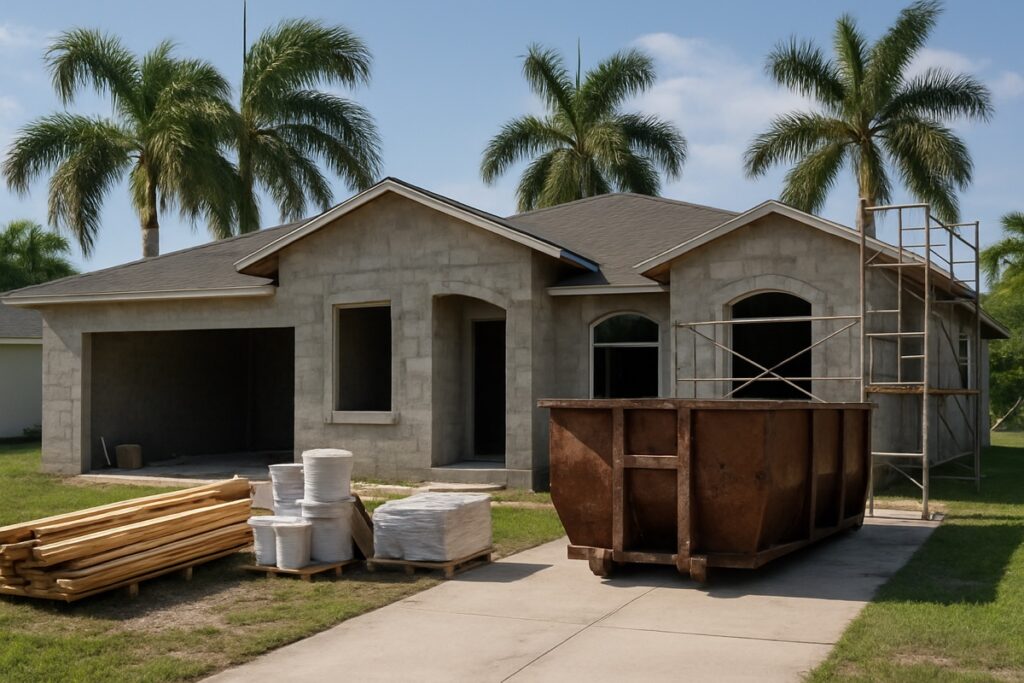
Planning an Estero whole home remodel budget in 2026 requires more precision than a quick online calculator can provide. Estero sits squarely in Lee County’s Wind Zone IV, where 140–150 mph design wind speeds, year-round humidity above 70%, and proximity to Estero Bay drive material and labor choices that bear little resemblance to national averages. Whether you own a mid-1990s concrete-block CBS home in The Reserve at Estero or a newer slab-on-grade villa near Pelican Sound, understanding how to layer your scope, sequence your trades, and protect yourself with the right contingency fund will determine whether your project finishes on budget, or becomes a costly lesson. Read through this guide to learn how seasoned Southwest Florida contractors structure whole-home remodel costs, which line items surprise homeowners most, and how to prepare before the first permit is pulled.
How Estero Home Characteristics Shape Your Starting Budget
Before you can assign a dollar figure to your remodel, you need to understand what the house itself is telling you. The vast majority of Estero homes were built between 1985 and 2010 on slab-on-grade foundations using concrete-block (CBS) construction. That combination creates a specific set of opportunities and complications that directly affect your budget.
Slab-on-grade plumbing is embedded in or beneath the concrete slab. Relocating a kitchen sink, adding a bathroom, or rerouting drain lines requires cutting through the slab: a process that can add $3,000–$8,000 per wet-location move depending on depth and accessibility. Budget for a plumbing camera inspection before finalizing your design drawings; a $350–$500 diagnostic can save tens of thousands in change orders later.
CBS walls also require different fastening systems, electrical rough-in methods, and insulation strategies than wood-frame construction. Adding recessed lighting in a CBS wall chase or running new circuits means masonry anchors, conduit routing, and patching; all of which slow trade labor and increase costs compared to a wood-frame home in, say, Charlotte County.
Tile roofs, which dominate Estero neighborhoods, carry their own budgetary weight. If your project disturbs the roof line (adding a dormer, a skylight, or expanding a lanai opening) you’ll need a licensed roofing sub who can source matching tile, which may be discontinued. Budget a $2,000–$5,000 tile-matching allowance for any project that touches the roofline.
Finally, homes within five miles of Estero Bay face accelerated salt-air corrosion. Exterior hardware, fasteners, and window frames must be rated for a coastal environment; aluminum rated to ASTM B117 salt-spray standards or stainless-steel hardware adds 10–15% to exterior line items but is non-negotiable for longevity. As a licensed Florida general contractor, Alliance Construction factors these site-specific details into every preliminary estimate.

Realistic Cost Ranges for Estero Whole-Home Remodels in 2026
Southwest Florida labor and materials markets have stabilized somewhat after the post-Ian surge, but they remain 18–25% above pre-2020 national benchmarks. Here is how full-home remodel costs break down by scope tier in Lee County for 2026:
- Cosmetic refresh (paint, flooring, fixtures, cabinet refacing): $40–$75 per square foot. A 2,000 sq ft home lands at $80,000–$150,000.
- Mid-level gut-and-remodel (kitchens, baths, flooring, electrical panel upgrade, impact windows): $95–$150 per square foot, or $190,000–$300,000 for the same 2,000 sq ft home.
- Premium whole-home renovation (custom cabinetry, natural stone, whole-house generator, new roof, full plumbing re-route): $160–$240+ per square foot.
The single biggest variable inside those ranges is the kitchen. A semi-custom kitchen remodel in Estero runs $45,000–$85,000 all-in, including cabinets, quartz or granite countertops, appliances, tile backsplash, and trade labor. Upgrading to fully custom cabinetry with quartzite or waterfall-edge porcelain slab countertops pushes that number to $100,000–$140,000 for a moderately sized kitchen.
Bathrooms typically run $18,000–$35,000 for a primary suite bath with large-format tile, frameless glass enclosure, and a freestanding soaker tub. Secondary baths land in the $10,000–$18,000 range with ceramic tile, semi-custom vanities, and standard fixtures.
Flooring for the whole home runs $8–$18 per square foot installed, depending on material. Luxury vinyl plank (LVP) at $8–$11 per square foot installed is the dominant choice in Estero because it handles humidity swings without warping. Engineered hardwood is viable in air-conditioned spaces at $12–$16 per square foot, but solid hardwood is not recommended in SWFL’s year-round AC environment. Shell-stone or travertine pavers for outdoor living areas add $14–$22 per square foot installed.
Impact windows and doors (required by the current Florida Building Code for any permit-pulled remodel that triggers a full envelope review) run $800–$1,400 per opening for standard sizes and up to $3,500+ for large picture windows or sliding glass doors with hurricane impact glass. For a home with 20 openings, budget $20,000–$40,000 for the window package alone. Verify current Florida Building Code requirements with your contractor before finalizing your scope.
Phasing a Large Remodel to Control Cash Flow
Not every Estero homeowner can (or should) tackle all scopes simultaneously. Intelligent phasing preserves cash flow, lets you absorb contractor schedules realistically, and reduces the chaos of living through a construction zone. Here is a proven three-phase framework used on Southwest Florida whole-home projects.
Phase 1: Structural, Mechanical, and Code-Driven Work
Start with anything that requires opening walls or ceilings: electrical panel upgrades (common in pre-2000 Estero homes still on 150-amp service), HVAC replacement, plumbing re-routes, impact window installation, and roof work. This phase is the least glamorous but the most consequential. Lee County permit timelines for structural work currently run 3–6 weeks for residential permits, so submit drawings early. Mini-split heat pump systems: increasingly preferred over ducted systems in whole-home remodels because they allow zone control and reduce duct leakage in SWFL’s demanding cooling season: should be designed and permitted in this phase.
Phase 2: Kitchen, Baths, and Interior Finishes
Once mechanicals are roughed in and inspected, move to the high-ROI interior spaces. Kitchen lead times for semi-custom cabinets run 8–14 weeks; custom millwork can take 16–20 weeks. Order cabinet packages before Phase 1 is complete so delivery aligns with installation readiness. Install flooring after cabinets are set but before finish trim: a sequencing mistake that adds $2–$4 per square foot in floor protection and rework costs when reversed. A full kitchen-and-baths phase typically takes 6–10 weeks of active construction.
Phase 3: Outdoor Living, Lanai, and Landscaping
Lanai screen enclosures, pool deck resurfacing with travertine or Trex composite decking alternatives, and summer kitchen buildouts round out most Estero whole-home remodels. This phase can often proceed somewhat in parallel with Phase 2 if different trade crews are involved. Screen enclosure permits in Lee County require wind load calculations to meet 140 mph design criteria: confirm your contractor pulls a separate structural permit for any new or rebuilt enclosure.

Contingency, Allowances, and Hidden Cost Drivers
One of the most reliable ways to blow a remodel budget is to treat it as a fixed number rather than a managed range. Experienced Southwest Florida contractors (and the homeowners who work with them successfully) build three financial buffers into every project.
Contingency fund: Budget 10–15% of hard construction costs for unknowns. In Estero’s older housing stock, behind-wall discoveries are common: outdated aluminum branch-circuit wiring, improper prior-owner additions without permits, corroded plumbing from decades of hard well water, or inadequate attic insulation (Florida Building Code requires R-30 minimum in Climate Zone 2, and many pre-2000 homes fall short). A $250,000 project should carry a $25,000–$37,500 contingency line.
Allowances: When materials have not been selected at contract signing (tile, plumbing fixtures, appliances, lighting) your contractor should include an allowance figure. Make sure allowances reflect real Estero market pricing, not national box-store averages. A $500-per-fixture plumbing allowance will not cover the Delta or Kohler fixtures most Estero homeowners select; $800–$1,200 per fixture is more accurate for a mid-level remodel.
Snowbird timing premium: Many Estero homeowners are seasonal residents. If you want the project complete before the November snowbird arrival, that schedule compression can add 8–12% in accelerated labor costs. Plan your permit submission date backward from your target occupancy date, accounting for Lee County’s 3–6 week permit window and typical trade lead times.
Hidden cost drivers unique to SWFL also include: FEMA flood zone elevation requirements that affect any work below base flood elevation, permit fees that scale with project valuation (typically 1.5–2% of construction value in Lee County), and HOA architectural review timelines that can add 30–60 days before a permit application is even filed. Address all three in your pre-construction planning. For a detailed look at what full remodeling in this market involves, see our Estero remodeling services page.
Choosing Materials and Finishes That Hold Up in Estero’s Climate
Finish selections are not just aesthetic decisions in Southwest Florida; they are durability decisions. Here is how material choices translate into real long-term value in Estero’s climate.
Countertops: Quartz outperforms granite in SWFL kitchens because it is non-porous and resists the mold that year-round 70%+ humidity can seed in unsealed granite. Porcelain slab countertops are the emerging premium alternative: extremely dense, UV-stable for outdoor kitchen applications, and available in large formats that minimize seams. Budget $75–$110 per square foot installed for quartz; $90–$130 for porcelain slab.
Flooring: LVP with a 12-mil wear layer and a 100% waterproof core is the practical standard in Estero homes. Avoid direct-glue-down products on slab: floating installation with an underlayment membrane accommodates the micro-movement that SWFL’s thermal cycling causes. Large-format ceramic or porcelain tile (24×24 or 32×32) is equally durable and preferred in main living areas by many homeowners for its cool-surface benefit during summer.
Cabinets: In wet areas (bathrooms, laundry rooms, outdoor kitchens) specify plywood box construction over particleboard. Particleboard swells irreversibly when exposed to the humidity intrusion common during power outages after storms. Semi-custom all-plywood cabinets from brands common in the SWFL supply chain typically run $350–$600 per linear foot installed; fully custom millwork starts around $700 per linear foot.
Exterior finishes: Fiber cement siding where used, impact-rated stucco systems, and powder-coated aluminum for any exterior trim or railings. Paint systems on exterior masonry should be elastomeric (not standard latex) to bridge the micro-cracks that develop in CBS walls over time without admitting water. A properly specified elastomeric system adds $1.50–$2.50 per square foot versus standard paint but can extend repainting cycles from 5–7 years to 10–12 years in a coastal environment.
Frequently Asked Questions
How long does a whole-home remodel take in Estero?
A full-scope whole-home remodel in Estero typically runs 4–9 months from permit issuance to final inspection, depending on scope complexity, material lead times, and phasing. Projects that include custom cabinetry, impact windows, and structural modifications sit at the longer end of that range. Lee County permit approval alone adds 3–6 weeks before any construction begins, so factor that into your move-out or rental planning timeline.
Do I need permits for a whole-home remodel in Lee County?
Yes. Any work involving structural elements, electrical, plumbing, HVAC, roofing, or impact windows requires a permit in Lee County. Unpermitted work creates serious problems at resale: title companies and buyers regularly require permit histories. Alliance Construction pulls all required permits as part of every project, ensuring work meets current Florida Building Code standards and passes all required inspections before project closeout.
What contingency percentage should I set aside for an Estero remodel?
Budget 10–15% of hard construction costs as a contingency reserve. Estero’s older CBS housing stock frequently reveals behind-wall issues (outdated wiring, corroded plumbing, inadequate insulation) that require remediation once walls are opened. A 15% contingency is appropriate for homes built before 2000 or for projects with significant wet-area relocations on slab-on-grade foundations where plumbing reroutes are likely.
Is it worth doing a whole-home remodel versus buying a newer Estero home?
In the current Lee County market, a well-executed whole-home remodel on an Estero CBS home often delivers stronger cost-per-square-foot value than purchasing a comparable newly built or renovated home at today’s elevated prices. You also retain your established lot location and community. The calculus shifts if the existing home has significant structural or flood-zone issues: a licensed contractor inspection helps clarify that decision before you commit to either path.
Alliance Construction & Renovation is a licensed Florida general contractor serving Estero, Fort Myers, Cape Coral, Naples, and the surrounding Southwest Florida region. If you’re ready to size your project budget realistically and build a remodel plan that accounts for Lee County permitting, SWFL material realities, and your specific home’s construction, call us at (239) 771-2855 to schedule a consultation. You can also learn more about our full scope of work on our Estero remodeling services page. The earlier you engage a contractor in the planning process, the more accurate your budget, and the fewer surprises during construction.
For a wider view of local demand, our Southwest Florida Home Remodeling Demand Report shows which projects Estero and SWFL homeowners are asking about most.