


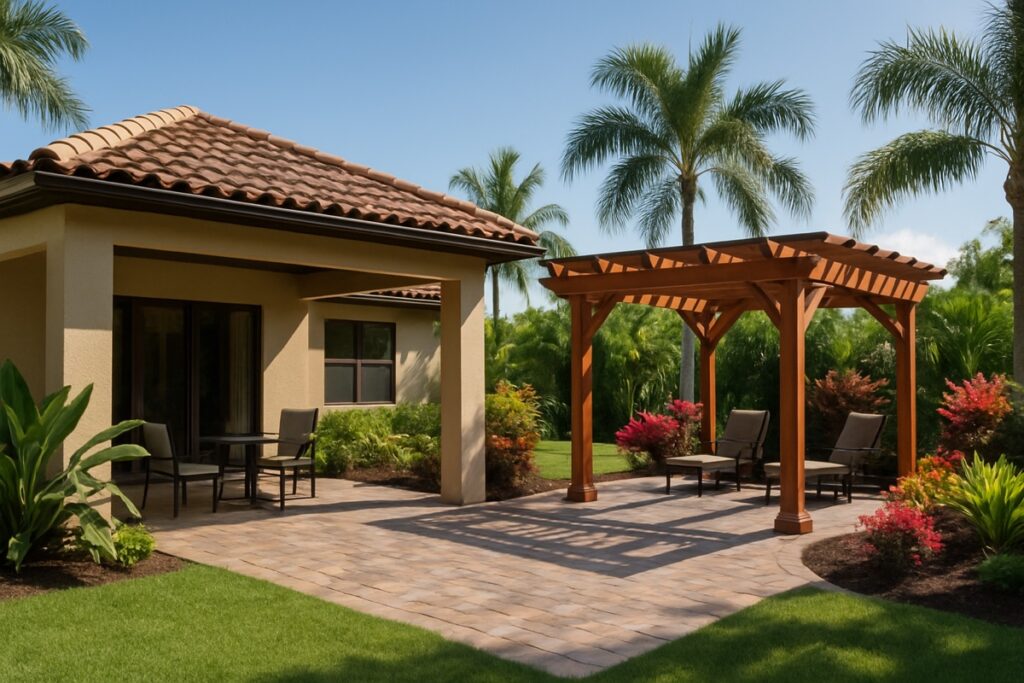
Deciding between a pergola vs covered lanai for Fort Myers backyards is one of the most common questions Southwest Florida homeowners face when expanding their outdoor living space. Both options can transform a plain concrete slab or grass area into a functional retreat, but they perform very differently under SWFL’s year-round heat, 70%-plus humidity, and the reality of hurricane-force winds that regularly exceed 140 mph design thresholds in Lee County. The wrong choice can mean years of dissatisfaction, failed permit inspections, or a structure that doesn’t survive its first named storm. This guide walks through the practical differences (shade coverage, weather protection, code requirements, costs, and resale impact) so you can make a confident, informed decision before breaking ground.
How Each Structure Functions in Southwest Florida’s Climate


A pergola is an open-roof structure (typically a series of rafters or lattice beams supported by posts) that provides partial shade and a defined outdoor space without enclosing you from rain or wind. A covered lanai, by contrast, is a fully roofed outdoor room, usually attached to the main house, with a solid or screen-enclosed ceiling that keeps rain, direct sun, and insects out. In most of the country that distinction is a matter of preference, but in Fort Myers and the broader SWFL region, climate makes it a functional engineering question.
Fort Myers averages roughly 55 inches of rain per year, most of it falling in intense afternoon thunderstorms between June and September. A pergola’s open-lattice or open-rafter design offers zero rain protection. During a typical summer, you’ll lose several hours of backyard use per day because of fast-moving pop-up storms. A covered lanai with a hip roof or flat insulated ceiling panel eliminates that problem entirely; you can sit outside through a downpour without getting wet.
Year-round AC operation also matters here. A well-designed covered lanai creates a thermal buffer zone between your air-conditioned interior and the 93°F summer exterior, reducing heat gain through rear-facing glass doors and windows. An open pergola provides almost no thermal benefit and can actually increase reflected heat onto adjacent glass.
Humidity is the other variable. At 70%-plus relative humidity for most of the year, wood pergolas require meticulous upkeep. Pressure-treated pine will begin showing surface mold within 12 to 18 months without regular sealing. Aluminum or powder-coated steel pergola frames are far more appropriate for saltwater proximity, especially within 5 miles of the Gulf coast, where salt-air corrosion accelerates fastener and framing degradation significantly.
Outdoor Living Functionality, Comfort, and Use Patterns
Beyond code and cost, how you actually use the space should drive the decision. Fort Myers homeowners (including a significant snowbird population that occupies homes from November through April) often use outdoor spaces differently than year-round residents. If you’re primarily entertaining during the dry season (November–May), a pergola may provide all the coverage you actually need during your occupancy window. If you live here year-round, the rainy-season usability gap of an open pergola is significant.
Pool decks are a common context for both structures. A pergola positioned adjacent to a pool creates a shaded lounge area without enclosing the pool itself, preserving sightlines and natural air movement: an advantage when temperatures drop below 80°F and Gulf breezes make open-air seating pleasant. A covered lanai pool enclosure (a cage structure surrounding both the lanai and pool) is the dominant format in SWFL because it keeps debris out of the pool, reduces evaporation, and provides insect protection year-round. Outdoor living additions that combine a roofed lanai with a screen cage and an adjacent pool deck are consistently among the highest-value backyard investments in this market.
Flooring material choices differ between the two. Travertine and shellstone pavers are popular on SWFL lanais because they stay cooler underfoot than concrete or dark porcelain in direct sun. LVP (luxury vinyl plank) is increasingly used in fully enclosed Florida rooms where the space approaches interior conditions. Trex composite decking or treated-wood decking is more common on freestanding pergola platforms raised above grade.
Outdoor kitchen integration is another differentiator. A fully roofed lanai makes an outdoor kitchen practical in Southwest Florida: protecting appliances, cabinetry, and countertops from daily afternoon rain. An open pergola requires more weather-resistant cabinetry (typically stainless steel or marine-grade polymer) and more diligent maintenance of exposed surfaces.
Resale Value and Buyer Perception in Fort Myers and Lee County

Both structures add perceived value to a Fort Myers home, but they don’t perform equally in the resale market. SWFL buyers have strong preferences shaped by lifestyle expectations and insurance awareness. A well-built, permitted covered lanai (especially one with a screen enclosure, outdoor kitchen rough-in, and quality pavers) is treated by buyers and appraisers as a genuine living space addition. Appraisers in Lee County regularly credit permitted lanai additions at 50 to 75 cents on the dollar of construction cost.
A pergola adds visual appeal and can improve first impressions, but buyers are increasingly aware that it requires maintenance, may need re-engineering documentation to satisfy insurance underwriters, and doesn’t expand usable living area in the same functional sense. In the current Fort Myers resale market (particularly in neighborhoods where CBS (concrete block and stucco) homes from the 1980s and 1990s are common) buyers comparing two similar homes often favor the one with a solid, permitted lanai addition over one with a decorative pergola.
That said, a pergola paired with a well-landscaped backyard and pool deck can be highly effective for mid-range homes in Lehigh Acres, North Fort Myers, and Cape Coral, where price points make a $50,000 lanai addition less attractive relative to the home’s overall value. In those markets, a properly permitted aluminum pergola at $12,000 to $20,000 may generate a better return-on-investment than a full lanai build-out.
The key in either case is permitted, code-compliant work performed by a licensed Florida general contractor: unpermitted structures in Lee County can trigger permit holds that delay or kill real estate transactions.
For more on planning shaded outdoor structures, see This Old House’s outdoor living resources.
Frequently Asked Questions
Do I need a permit for a pergola in Fort Myers?
Yes. Any permanent freestanding or attached structure in Lee County requires a building permit. This includes pergolas, regardless of size. You’ll need engineered drawings showing wind-load compliance for the 140–150 mph design wind speed that applies to Lee County. Skipping the permit creates liability, insurance complications, and potential resale problems. A licensed general contractor can handle the submittal and inspection process for you.
Can a pergola survive a hurricane in Southwest Florida?
A properly engineered, permitted aluminum pergola with hurricane-rated post anchors and code-compliant beam connections can survive most Category 1 and Category 2 events. It will not perform as well as a fully roofed lanai tied to the main structure. Open-lattice designs and motorized louvered roofs should be closed and secured before storm arrival. Wood pergolas are generally more vulnerable to hurricane-force wind events due to the difficulty of achieving equivalent uplift resistance.
What is the difference between a screen enclosure and a covered lanai?
A screen enclosure (or screen cage) is an aluminum-framed structure with screen mesh panels and typically a screen or lightweight roof (it keeps insects and debris out but doesn’t provide a solid weather-proof ceiling. A covered lanai has a solid roof structure) hip, gable, or flat; that provides full rain protection. Many SWFL homeowners combine both: a solid-roofed lanai section adjacent to a screen-enclosed pool cage.
How long does it take to build a covered lanai addition in Fort Myers?
From design and permitting through construction, a covered lanai addition in Fort Myers typically takes 3 to 5 months total. The permit review phase alone runs 4 to 12 weeks at Lee County Building. Construction time once permits are in hand is generally 3 to 6 weeks for a standard roofed and screened lanai. More complex projects involving structural tie-ins, outdoor kitchens, or pool deck work take longer.
Whether a pergola or a covered lanai is the right fit for your Fort Myers backyard depends on your budget, how you’ll use the space, and how important year-round weather protection is to your family. Alliance Construction & Renovation is a licensed Florida general contractor serving Lee, Collier, and Charlotte counties; we pull permits, deliver code-compliant work, and have built both structures throughout Fort Myers, Cape Coral, Naples, and Lehigh Acres. Call us at (239) 771-2855 to schedule a consultation, or visit our outdoor living page to explore project examples and get started on your backyard addition.