


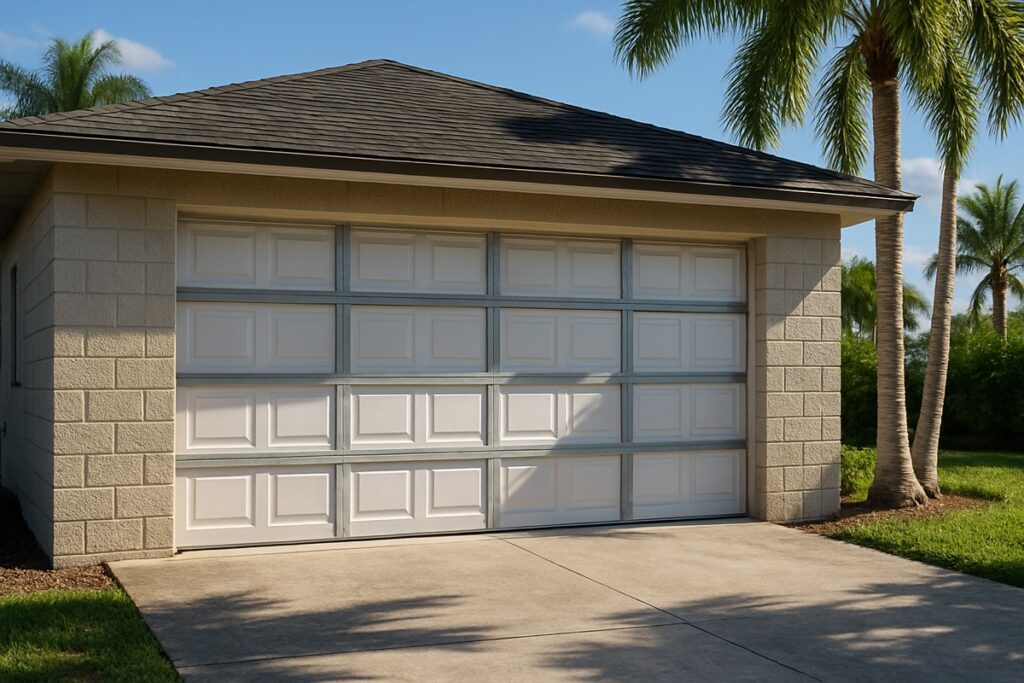
If you’ve lived in Fort Myers for more than a few years, you already know how quickly a named storm can shift from a Gulf watch to a landfalling hurricane bearing 140-mph sustained winds. One of the most vulnerable spots on any house during that event is the garage door, and a standard builder-grade panel door simply isn’t engineered for that kind of pressure loading. A hurricane rated garage door Fort Myers homeowners install today is designed to resist both positive and negative wind loads, keep the building envelope intact, and (critically) prevent the pressure differential that can lift an entire roof structure. This post walks through what Florida code actually requires, what a compliant upgrade costs, how it affects your insurance premium, and what to ask a contractor before you sign anything.
Why the Garage Door Is the Weak Link in the Building Envelope
Structural engineers have studied hurricane damage patterns in Southwest Florida since Hurricane Charley tore through Charlotte County in 2004 at 150 mph. The findings are consistent: garage doors fail at a higher rate than almost any other component. The reason is physics. A typical two-car garage door spans 16 feet wide by 7 feet tall; that’s 112 square feet of surface area exposed to wind pressure. At 130 mph, the dynamic load on that panel can exceed 55 pounds per square foot. Standard residential doors are rated for far less.
When a garage door fails mid-storm, two things happen almost simultaneously. First, wind and rain pour into the garage, pressurizing the interior. Second, that pressure spike loads the ceiling above; often the floor of a second story or, on single-story slab-on-grade CBS homes common throughout Lee County, the underside of the roof deck. The result is a dramatically elevated risk of partial or total roof loss. FEMA’s post-storm assessments of Florida neighborhoods consistently flag garage door failure as a primary trigger for catastrophic interior damage.
The good news is that the Florida Building Code, 7th Edition addresses this directly. Section 1609 and the referenced ASCE 7-22 standard require that all new garage door openings in Lee, Collier, and Charlotte counties be protected to withstand design wind speeds of 140–150 mph, depending on exact location and exposure category. Replacement doors on existing homes must meet the same standard when a permit is pulled.

What Florida Code Actually Requires for Hurricane-Rated Garage Doors
Understanding the code is easier when you break it into three components: wind-load rating, product approval, and installation method. All three have to be correct for the door to provide the protection it’s marketed for.
Wind-Load Rating and Product Approval Numbers
Every garage door sold for installation in Florida’s High-Velocity Hurricane Zone (HVHZ) or the broader Wind-Borne Debris Region must carry a Florida Product Approval number (FL#) issued by the Department of Business and Professional Regulation. That number confirms the door was tested per ANSI/DASMA 115 or an equivalent standard and met the required positive and negative design pressures. For a typical Fort Myers single-family home in Exposure Category C (open terrain, most suburban neighborhoods) you’re looking for a door rated to at least ±55 to ±65 psf. Coastal properties within about a mile of the Gulf, Charlotte Harbor, or Estero Bay may require higher ratings depending on the site-specific wind speed map.
Bracing Systems and Horizontal Tracks
A high wind-load door isn’t just a thicker panel. The track system, spring assembly, and any supplemental bracing all have to be part of the same tested system. Many non-compliant installations use an approved panel with mismatched tracks: a combination that voids the product approval entirely. Lee County permit reviewers look at the full system documentation, not just the door brand. Vertical and horizontal track gauges, hinge ratings, and end-stile reinforcement all appear in the engineering package.
Garage Door Bracing Kits as an Alternative
If a full door replacement isn’t in the immediate budget, some jurisdictions accept a field-installed bracing kit (horizontal steel struts bolted to the door panels) as an interim measure. These kits can raise a door’s pressure rating significantly. However, they must still carry a Florida Product Approval number, they require a permit, and they typically add $300–$600 to an existing door rather than serving as a long-term solution. Alliance’s licensed general contracting team can assess whether bracing is code-compliant for your specific home or whether a full replacement makes more structural and financial sense.
Cost Breakdown: What a Hurricane-Rated Garage Door Upgrade Runs in SWFL
Pricing in Fort Myers and the broader Southwest Florida market breaks down into materials, installation labor, permit, and disposal of the old door. Here’s a realistic range based on current market conditions:
- Single-car door (8×7 ft), steel, wind-rated: $900–$1,400 installed, permit included
- Two-car door (16×7 ft), steel, wind-rated: $1,500–$2,400 installed, permit included
- Two-car door (16×7 ft), impact-rated aluminum with windows: $2,200–$3,500 installed
- Custom wood-look composite hurricane door: $3,500–$6,000+ depending on size and finish
- Lee County permit fee: Typically $75–$200 for a replacement door
Keep in mind that the permit is non-optional on a hurricane-rated replacement in Lee County. Unpermitted work means no product approval inspection, which means your insurer can deny the wind mitigation credit entirely, and potentially dispute a future claim. Our licensed general contracting services always include permit-pulled, inspected work so there are no gray areas at claim time.
Steel remains the most common material for cost-effective hurricane compliance. Gauge matters: 24-gauge steel doors are noticeably stiffer under wind load than the 28-gauge panels common on builder-grade products. If aesthetics matter (and they often do in Naples or Bonita Springs neighborhoods with HOA architectural guidelines) fiberglass and aluminum composite doors can match wood-grain or contemporary looks while still achieving required pressure ratings.


Insurance Premium Impact: Wind Mitigation Credits in Florida
This is where the financial case for a hurricane rated garage door Fort Myers homeowners install often becomes very clear. Florida’s Citizens Property Insurance Corporation and most private carriers operating in Lee, Collier, and Charlotte counties use the OIR-B1-1802 Wind Mitigation Inspection form to calculate premium discounts. The opening protection section of that form (which covers windows, entry doors, and garage doors) can account for a substantial share of the total wind mitigation credit.
A home where all openings, including the garage, are protected by tested, compliant products is classified as having “opening protection: rated.” That designation, combined with other features like hip roof geometry, roof-to-wall connectors, and secondary water resistance (peel-and-stick membrane underlayment), can reduce the wind portion of a Florida homeowner’s insurance premium by 20–45%. On a policy in Lee County where wind premiums routinely run $3,000–$6,000 per year, that’s $600–$2,700 in annual savings.
Practically speaking, a two-car hurricane-rated garage door that costs $2,000 installed can pay for itself in insurance savings within two to four years. That’s before accounting for the avoided cost of a failed door during a storm, which, factoring in emergency repairs, roof damage, interior water intrusion, and contents loss, routinely runs $15,000–$50,000 on a typical SWFL home.
To capture the credit, you’ll need a licensed wind mitigation inspector to complete the OIR form after installation. They’ll verify the Florida Product Approval number, confirm the door was installed per the manufacturer’s approved method, and check that the permit received a final inspection. Keep all documentation (the permit card, product approval printout, and installer invoice) in a home file. Insurers occasionally request re-verification after claims.
Snowbird owners with properties in Estero, Punta Gorda, or North Fort Myers that sit unoccupied for months at a time have even more to gain. A structurally intact garage door means that if a storm passes during the off-season, the home interior remains protected until you can return and assess the situation; rather than arriving to find months of mold and water damage throughout a previously dry CBS structure.
Choosing the Right Door and Contractor for Your Fort Myers Home
Not every garage door company advertising “hurricane doors” in Southwest Florida is pulling permits, using fully-tested track systems, or carrying the licensing required for structural work. Here’s what to verify before hiring:
- Florida Contractor License: Ask for the license number and verify it at the DBPR website. A garage door replacement in a wind-borne debris region is regulated work.
- Product Approval Number: Request the FL# for the specific door model and track system before signing a contract. Cross-check it on the DBPR product approval database.
- Permit confirmation: The contractor should pull the permit, not ask you to do it. Permit fees should be itemized in the written quote.
- Warranty clarity: Manufacturer warranties on panels typically run 10–20 years on paint, 1–5 years on hardware. Ask what’s covered and what isn’t.
- Coordination with whole-home projects: If you’re also upgrading impact windows, doing a whole-home remodel in Cape Coral, or reroofing, sequencing the garage door work with other trades can save mobilization costs.
Material selection also intersects with the salt-air environment. Properties within five miles of the Gulf Coast, Charlotte Harbor, or the Caloosahatchee River see accelerated corrosion on galvanized steel springs, hinges, and track hardware. Stainless-steel hardware upgrades (typically $100–$250 additional) are worth every dollar on coastal lots. Aluminum doors with powder-coat finishes outperform painted steel in marine exposure over a 15–20 year horizon, even if the initial cost is higher.
Frequently Asked Questions
Does a hurricane-rated garage door require a permit in Fort Myers or Lee County?
Yes. Any garage door replacement in Lee County’s wind-borne debris region (which includes virtually all of Fort Myers) requires a building permit and a final inspection. The permit confirms the door carries the correct Florida Product Approval number for your specific wind speed zone and that the installation matches the tested system. Skipping the permit voids wind mitigation credit and can create complications at resale or during a claim.
How do I know if my current garage door is already hurricane-rated?
Look for a label on the inside of the top panel or the interior side stile that lists a Florida Product Approval number (FL#) and a design pressure rating in psf. If no label exists, or if the door predates the current Florida Building Code adoption, it almost certainly doesn’t meet current requirements. A licensed contractor can pull the FL# and cross-reference it against your site’s required design pressure to confirm compliance.
Can I add a hurricane brace kit to my existing door instead of replacing it?
In some cases, yes, but only if the brace kit itself carries a Florida Product Approval number and is compatible with your existing door panel construction. Kits cost roughly $300–$600 installed and can raise a door’s rated pressure meaningfully. However, spring hardware, tracks, and hinges still need to be evaluated. A bracing kit alone won’t typically qualify a door for the full “opening protection: rated” wind mitigation credit that a compliant replacement would earn.
How long does a hurricane-rated garage door installation take?
A straightforward replacement on a standard two-car opening typically takes four to six hours for the physical installation. Add a few business days on either end for permit issuance (Lee County’s standard turnaround on simple door replacements is generally five to ten business days online) and scheduling the final inspection. If structural work is needed at the opening (rotted header, out-of-square framing), that adds time and cost. Plan for the full process to take one to two weeks from contract signing to final inspection.
Alliance Construction & Renovation is a licensed Florida general contractor serving Fort Myers, Cape Coral, Naples, Bonita Springs, and the surrounding Southwest Florida region. If you’re ready to bring your garage door into compliance, lower your insurance premium, and close the biggest gap in your building envelope, call us at (239) 771-2855 to schedule a consultation. You can also explore our full scope of general contracting services to see how we coordinate permit-pulled work across every trade; so your home is protected correctly, the first time.


We Serve Southwest Florida
Alliance Construction provides remodeling services in Cape Coral, Naples, Bonita Springs, Estero, North Fort Myers, and Punta Gorda. View all services →